- Researchers have created an atomic clock, built from the element lutetium, which they say can measure a trillionth of a second accurately and is the most stable one across environments, hardly feeling changes in temperature or magnetic field.
- The clock achieved a record uncertainty of 1 x 10-19, surpassing all previously reported figures for optical atomic clocks.
- The comparison of two independent clocks yielded an uncertainty of 5.7 x 10⁻¹⁹, marking the most precise clock comparison ever documented.
- Team leader Murray Barrett expressed confidence that this is the most accurate clock in the world.
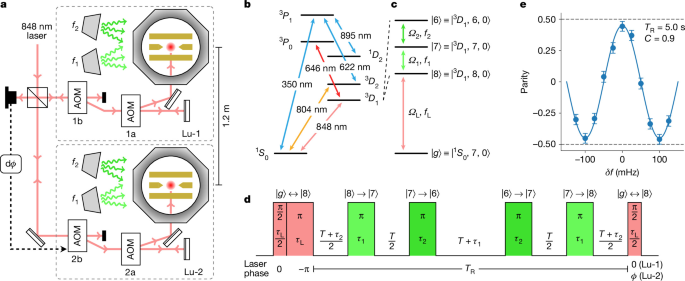
- Each lutetium clock consists of a single charged Lu+ ion having a clock transition matched to a laser with wavelength of 848 nanometers.
- Unlike caesium, the element underpinning the global time standard since the 1960s, lutetium exhibits minimal sensitivity to environmental factors like temperature and magnetic fields, contributing to its exceptional stability.
A lutetium atomic clock constructed by researchers at Singapore's Centre for Quantum Technologies has achieved a record uncertainty of 1 x 10-19, surpassing all previously reported figures for optical atomic clocks. This clock measures time with such precision that it loses or gains approximately one second every 300 billion years.1
Team leader Murray Barrett expressed confidence in the clock's capabilities, stating, "I am confident that what we have now is the most accurate clock in the world." The clock's design utilizes a single charged lutetium-176 ion, excited by a laser with a wavelength of 848 nanometers, which contributes to its exceptional stability.56

Unlike the caesium-based clocks that have defined global timekeeping since the 1960s, the lutetium clock exhibits minimal sensitivity to environmental factors such as temperature and magnetic fields. Barrett noted, "The good properties mean that high accuracy can be achieved even in a wide range of environments." This stability allows the clock to function effectively in extreme conditions, from the hottest places on Earth to the coldest.7
The researchers conducted a clock comparison using a technique known as correlation spectroscopy over 200 hours of measurement, yielding an uncertainty of 5.7 x 10⁻¹⁹, marking the most precise clock comparison ever documented. First author Kyle Arnold emphasized the importance of comparing clocks to test accuracy, stating, "The only way to test the accuracy of a standard is to compare clocks and demonstrate reproducibility."34
“The clock's uncertainty of 1 x 10-19 means it loses or gains about one second every 300 billion years, enabled by lutetium's minimal sensitivity to temperature and magnetic fields. The team validated this by comparing two independent clocks over 200 hours, yielding a 5.7 x 10⁻¹⁹ comparison uncertainty, the most precise ever documented.”
 Quantum Zeitgeist