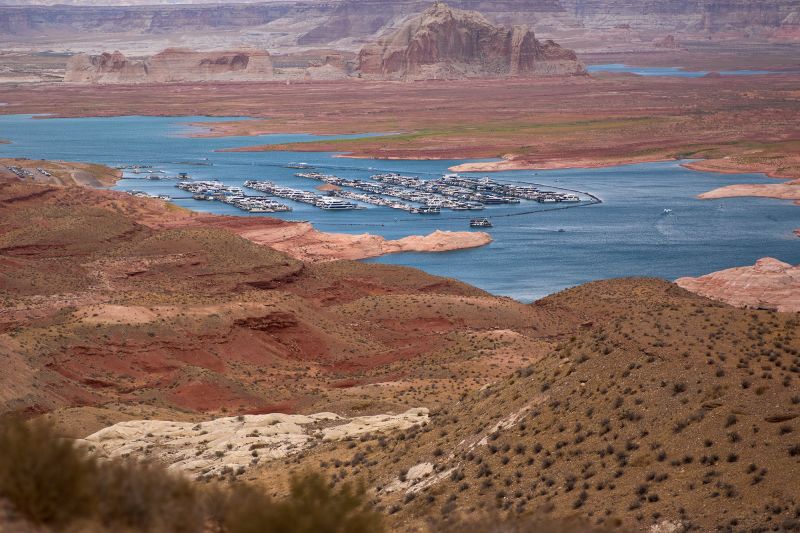
- Lake Powell has reached a record low of 3,519.91 feet, breaking the previous record of 3,519.92 feet set in April 2023, according to data from the US Bureau of Reclamation.
- The new record was confirmed on Saturday, with federal officials noting that the reading is provisional and may be revised.
- Climate change and heavy water use have contributed to the Colorado River shrinking by roughly 20% since 2000, exacerbating the situation.
- Experts warn that Lake Powell is approaching minimum power pool levels, which could threaten its ability to generate electricity.
- Jack Schmidt, director of the Center for Colorado River Studies, stated, "We are in uncharted territory" regarding the current water crisis.
- Lake Mead, the largest US reservoir, also dropped to its lowest level on August 7, marking a significant decline in water levels across the region.
- The Colorado River serves seven Western states and is crucial for agriculture, drinking water, and hydroelectricity.
- Climate change is altering precipitation patterns, leading to less water available for the Colorado River, according to experts.
Lake Powell's water level has plummeted to 3,519.91 feet, breaking its previous record low of 3,519.92 feet set in April 2023. This decline is attributed to climate change and excessive water use, leading to a 20% reduction in the Colorado River's flow since 2000.1378
Experts warn that the lake is approaching minimum power pool levels at 3,490 feet, which could jeopardize hydropower generation. Brad Udall, a senior water and climate research scientist, described this threshold as a “scary” point that could be reached this year without “extraordinary measures.” The situation is dire, with the potential for Lake Powell to hit “deadpool” levels below 3,370 feet, where water would cease to flow downstream.4
The Bureau of Reclamation is committed to mitigating risks to both Lake Powell and Lake Mead, which together hold 60% of the Colorado River's water. Jack Schmidt from Utah State University emphasized the unprecedented nature of this crisis, stating, “We are in completely new territory.” The ongoing drought, exacerbated by climate change, has led to a natural disaster scenario, affecting water availability for millions across the Southwest.56
Sharon Megdal, director of the Water Resources Research Center, noted that the current situation was not anticipated just a year ago, highlighting the urgent need for multiple years of good precipitation to recover the reservoir system. “If we were to get an exceptional year, such as what we got in 2023, we remain in crisis,” Schmidt warned.
“The reservoir's level is just under 30 feet from the point where its dam can no longer generate hydropower, and federal predictions suggest it could approach that threshold by early next spring. Meanwhile, Lake Mead, the largest US reservoir, also hit a record low nine days earlier, and the two reservoirs together hold less water than at any time since before Lake Powell existed.”
 ABC7 Los Angeles