- KAIST research team led by Kim Ji-han developed a technology that arranges gas molecules in orderly, crystal-like formations inside porous materials.
- The team used metal-organic frameworks, or MOFs, and identified a phenomenon called 'gas lattice' where gas molecules arrange regularly.
- They verified the phenomenon using xenon, finding it forms a body-centered cubic lattice inside Co-CAU-36.
- When xenon and krypton were introduced together, xenon formed a shell-shaped lattice while krypton settled in the center.
- The team used AI (machine learning and genetic algorithm) to design new porous structures that produce desired gas arrangements.
- The findings were published in Nature Communications on June 23.
KAIST's innovative technology employs artificial intelligence to design materials that arrange gas atoms in a crystal-like lattice, enhancing efficiency in carbon capture and hydrogen storage. Led by Professor Kim Ji-han, the research team discovered a phenomenon termed a "gas lattice", where gas molecules align in a structured formation within porous materials.1
The team utilized metal-organic frameworks (MOFs) to trap gas molecules, identifying that under specific conditions, these frameworks act as molds, guiding gas atoms into fixed positions. Their findings, published in Nature Communications, reveal that xenon gas can form a body-centered cubic (BCC) lattice inside a cobalt-based structure known as Co-CAU-36.234568
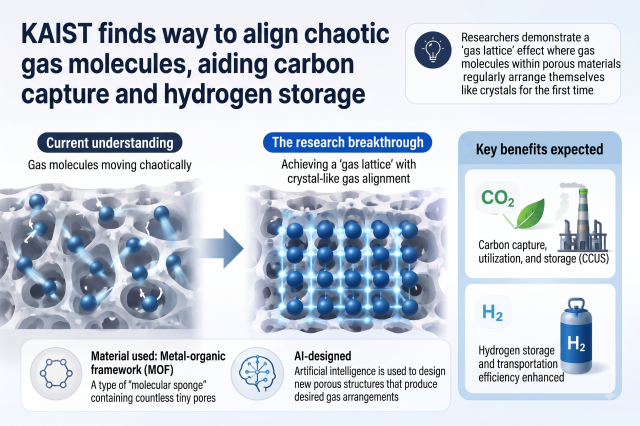
In experiments, when xenon and krypton were introduced together, xenon formed an ordered shell while krypton settled in the center, demonstrating the potential for selective gas separation. The researchers aim to extend this technology to capture and store gases like carbon dioxide and hydrogen, paving the way for tailored materials for specific applications.
Kim emphasized, "This study is the first case of lining gas up like a crystal inside a porous material. We have moved past thinking only about how much gas a material can hold, and opened the possibility of designing the arrangement itself." Although the research is currently theoretical, it holds promise for future advancements in gas storage and separation technologies.
“The team verified the effect with xenon, which formed a body-centered cubic lattice inside a cobalt-based MOF called Co-CAU-36. When xenon and krypton were mixed, xenon formed a shell while krypton collected in the center, demonstrating selective separation.”
 ajupress.com



