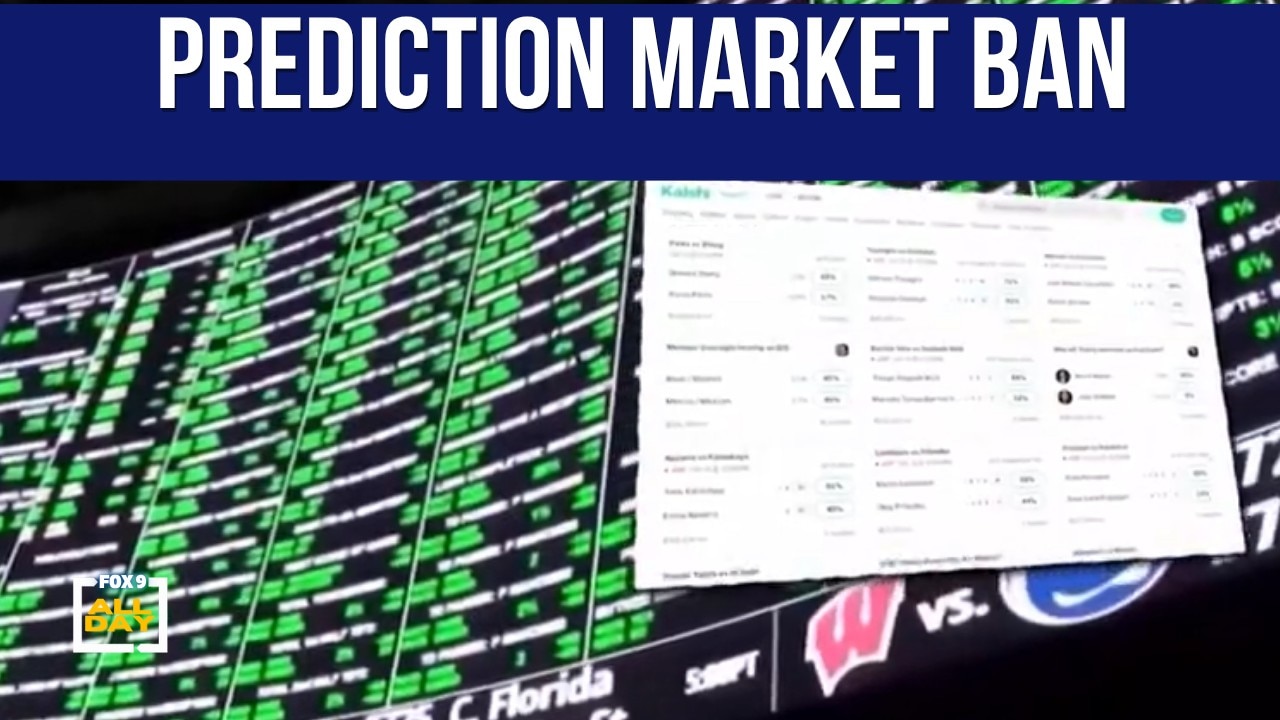
- Minnesota's law banning prediction markets was scheduled to take effect on Aug. 1, making it the first state to implement such a ban.
- A federal judge temporarily blocked the law just days before it was to take effect, marking a significant legal intervention.
- U.S. District Judge Katherine Menendez ruled that the law would cause 'irreparable harm' to prediction market operators, indicating a strong legal stance against the ban.
- The law would have made it a crime to create or operate prediction markets or help administer nearly any activity connected to one.
- The ban makes operating and advertising prediction markets a felony, highlighting the severity of the proposed legislation.
- Kalshi, Polymarket, and the Commodity Futures Trading Commission want the law permanently blocked, arguing that federal law gives the CFTC exclusive jurisdiction to regulate these transactions.
- Prediction markets allow people to bet on various events, and their regulation has become a contentious issue between state and federal authorities.
- Attorney General Keith Ellison stated that prediction markets are 'gambling, plain and simple,' reflecting the state's stance on the issue.
A federal judge has temporarily blocked Minnesota's first-in-the-nation law banning prediction markets, just days before it was set to take effect. U.S. District Judge Katherine Menendez ruled that the U.S. Commodity Futures Trading Commission (CFTC), along with companies Kalshi and Polymarket, were likely to succeed in their legal challenge against the law.348
Menendez's ruling emphasized that allowing the law to take effect would cause 'irreparable harm' to the operators. The law, which was to criminalize the creation and operation of prediction markets, had garnered bipartisan support and was scheduled to take effect on August 1.
Minnesota Attorney General Keith Ellison described prediction markets as 'gambling, plain and simple,' and expressed disappointment over the ruling, stating that it allows 'predatory gambling apps to proliferate.'9
Neal Kumar, Polymarket's chief legal officer, stated that the decision reinforces that prediction markets on commission-registered exchanges are governed by federal law, not state regulations. The CFTC has asserted its exclusive jurisdiction over such transactions, a stance supported by the Trump administration, which has been critical of state-level regulations.

The American Gaming Association estimates that states have lost over $1.2 billion in tax revenue due to the rise of prediction markets, highlighting the financial stakes involved in this legal battle.

As the litigation continues, Rep. Emma Greenman expressed hope that this is just the beginning of the fight over Minnesota's law.
“U.S. District Judge Katherine Menendez found that the Commodity Futures Trading Commission and prediction market operators were likely to succeed in their legal challenge against the law. Minnesota Attorney General Keith Ellison criticized the ruling, stating that prediction markets are 'gambling, plain and simple,' and expressed disappointment over the court's decision.”
 AP News
 MinnPost
 ABC News - Breaking News, Latest News and Videos



