
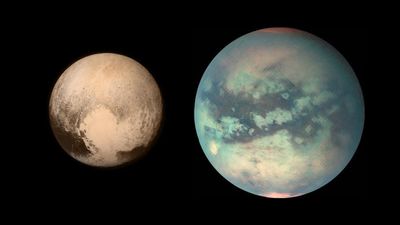
- Using the James Webb Space Telescope, researchers detected an unidentified chemical signature on Saturn’s moon Titan and on Pluto, both of which have nitrogen-and-methane atmospheres.
- The telescope found a narrow but clear gap in the infrared light coming from Titan, centered near 5.1 micrometers and absorbing about 6 to 7% of the light.
- Pluto’s version of the chemical fingerprint was weaker, about 4 to 5% deep, and roughly three times broader than Titan’s, but it’s undoubtedly the same substance.
- Researchers are unable to identify the material yet because its infrared fingerprint doesn’t match any laboratory spectra of compounds expected on Titan or Pluto.
- There is a mysterious substance on both Titan and Pluto's surfaces, and scientists aren't sure what it is.
- Both Titan and Pluto's atmospheres are mostly nitrogen and methane, leading to the production of haze particles that can snow down and accumulate on the surface.
- The weak feature in the light spectrum indicates that something on the surface is absorbing infrared light at a wavelength of 5.11 microns.
- Molecules known as tholins, composed of carbon and nitrogen, are common in Titan’s atmosphere, forming through a process known as photochemistry.
- The same compound is thought to be responsible for the dark red patches on both Pluto and its moon Charon.
- The feature on Pluto, while centered on the same wavelength as on Titan, is three times as broad.
- In 2028, a mission will launch to Titan, arriving in 2034, featuring a nuclear-powered flying vehicle that can move over the moon’s surface.
- The research team is collaborating with another group led by Jonathan Lunine to study the distribution of this mysterious compound on Titan's surface.
The James Webb Space Telescope has uncovered a mysterious chemical signature on Titan and Pluto, with a notable absorption feature at 5.11 microns. This finding, which absorbs 6 to 7% of light on Titan and 4 to 5% on Pluto, has left scientists baffled as it does not correspond to any known compounds.1237
Researchers, including Bézard, emphasize that both celestial bodies share nitrogen-and-methane atmospheres, leading to the formation of haze particles that accumulate on their surfaces. The exact nature of the substance remains elusive, with scientists noting, “There is a mysterious substance on both their surfaces, and scientists aren't sure what it is.”56
The infrared fingerprint detected does not match any laboratory spectra, complicating identification efforts. The team is actively collaborating with another group led by Jonathan Lunine to study the distribution of this compound on Titan's surface, while awaiting the Dragonfly mission, set to launch in 2028 and arrive in 2034. This mission will deploy a nuclear-powered vehicle to explore Titan's surface in detail.41112
The findings are significant as they hint at the complex chemistry occurring on these distant worlds, with molecules known as tholins prevalent in Titan's atmosphere, contributing to its unique surface characteristics. The same compounds are believed to cause the dark red patches observed on Pluto and its moon Charon.89
“The James Webb Space Telescope has identified a mystery chemical fingerprint on both Titan and Pluto. Researchers are currently unable to determine the exact nature of this substance.”
 ZME Science
 IFLScience