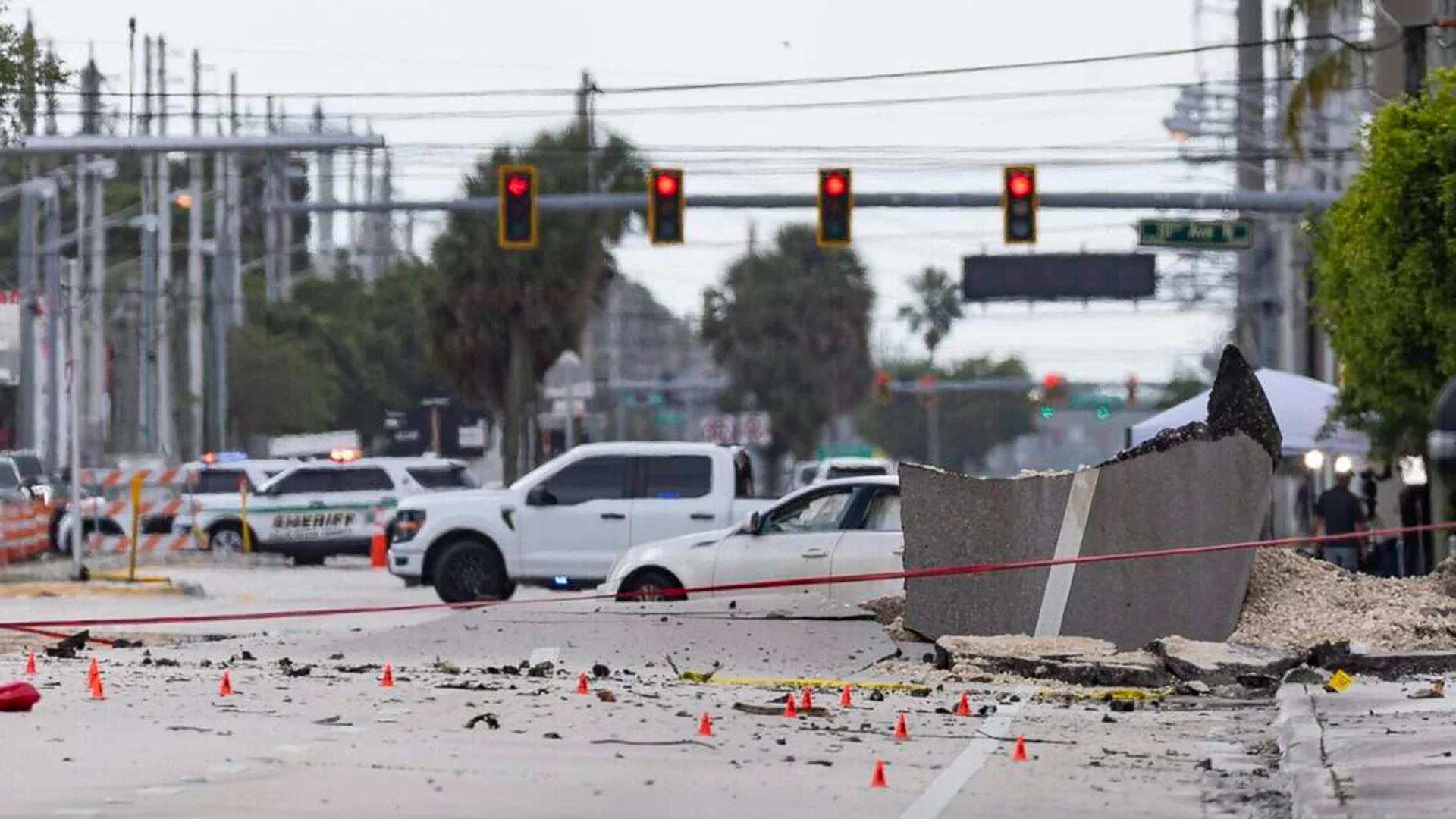
- Investigators found part of the tail of the jet that crashed in South Florida more than a mile from the crater caused when the aircraft made impact.
- National Transportation Safety Board member Tom Chapman said Monday that weather would be a key focus of the investigation.
- Parts were found up to 3.8 miles away from the impact site, confirming the jet broke apart before hitting the ground.
- Chapman confirmed that the tail's elevator was broken into three parts, indicating the plane was breaking apart before it hit the ground.
- The Learjet took off from Austin, Texas, and a preliminary report will be released in about a month.
- Chapman noted that without the elevator intact, the pilot would not have been able to pull the Learjet out of its nose dive.
Investigators are probing the weather conditions surrounding the Learjet crash in South Florida, where debris was found scattered over 3.8 miles from the impact site. The Learjet 60, which took off from Austin, Texas, crashed in Greenacres, about 7 miles southwest of West Palm Beach, on Sunday afternoon.
The National Transportation Safety Board (NTSB) revealed that parts of the jet's tail were discovered more than a mile from the crater created by the impact, indicating the aircraft was breaking apart before it hit the ground. NTSB member Tom Chapman stated, “The discovery of tail parts confirms the plane was breaking apart before it hit the ground.”
The tail's elevator was found in three pieces, which Chapman noted would have hindered the pilot's ability to control the aircraft during its descent. He explained, “The function of the elevator is to control the pitch up and down... knowing that it was lost is a very important piece of evidence.”
Co-pilot Nathalia Gadelha Filgueiras reported severe turbulence and ice accumulation shortly before the crash, screaming, “We're going to die!” as the jet plummeted. The impact created a crater and scattered debris widely, displacing about 600 nearby residents, though only one injury was reported on the ground. The NTSB is prioritizing weather in its investigation, with a preliminary report expected in a month, but a full determination of the crash's cause may take over a year.
“NTSB member Tom Chapman said the tail's elevator was broken into three parts, which would have prevented the pilot from pulling the Learjet out of its nose dive. He also noted that even if the elevator had been attached, its effectiveness at high speeds was uncertain.”