- Astronomers have uncovered new clues about the origin of a rare and powerful cosmic X-ray flash known as a Fast X-ray Transient (FXT), linking the event to either the collapse of a massive star or the merger of two neutron stars.
- The findings have been published in the Monthly Notices of the Royal Astronomical Society.
- An international team led by researchers from the Indian Institute of Astrophysics (IIA) has traced the origin of a rare Fast X-ray Transient (FXT) known as EP241107a, a fleeting burst of X-rays detected on November 7, 2024, by China's Einstein Probe mission.
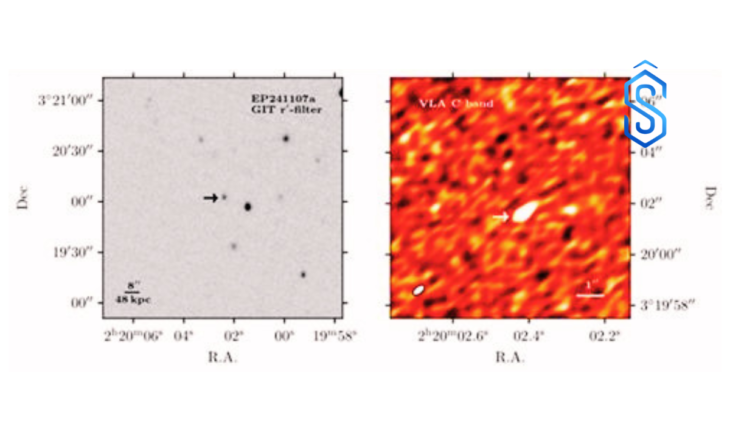
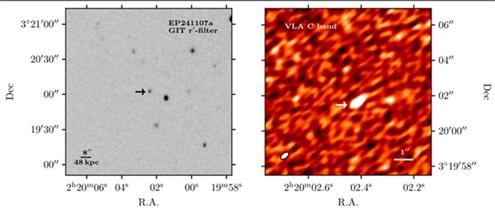
- The breakthrough came when the team identified a radio counterpart to the X-ray flash using the Karl G. Jansky Very Large Array in New Mexico, providing a crucial clue about the event's origin.
- No gamma rays were directly detected from the event, yet its afterglow strongly points to a gamma-ray burst origin, making EP241107a one of the clearest examples of what astronomers call an "orphan afterglow".
- According to the researchers, the jet carried kinetic energy comparable to the total energy emitted by all the stars in the Milky Way over several months.
- FXTs are energetic, non-repeating bursts of low-energy X-rays associated with violent cosmic events.
Indian astronomers have made significant strides in understanding Fast X-ray Transients (FXTs), tracing the origin of the rare X-ray flash EP241107a, detected on November 7, 2024, by the Chinese-led Einstein Probe mission.1357
The breakthrough came when researchers identified a radio counterpart to the X-ray flash using the Karl G. Jansky Very Large Array in New Mexico, providing crucial insights into the event's origin.4
After analyzing optical and radio data, the team concluded that EP241107a is likely linked to a gamma-ray burst, possibly resulting from the collapse of a massive star or the merger of two neutron stars.
The event's afterglow suggests a powerful jet was generated, with kinetic energy comparable to the total energy emitted by all stars in the Milky Way over several months, assuming isotropic radiation.6
Notably, no gamma rays were directly detected from EP241107a, making it an example of an "orphan afterglow", a cosmic explosion's lingering signature without an initial gamma-ray flash.
The findings, published in the Monthly Notices of the Royal Astronomical Society, enhance our understanding of these energetic, non-repeating bursts associated with violent cosmic events.2
“The jet carried kinetic energy comparable to the total energy emitted by all the stars in the Milky Way over several months,” the researchers noted.
This research marks a significant advancement in the study of FXTs and their origins, shedding light on the mechanisms behind these mysterious cosmic phenomena.
“An international team led by researchers from the Indian Institute of Astrophysics has traced the origin of a rare Fast X-ray Transient (FXT) detected on November 7, 2024. The findings suggest a link to either the collapse of a massive star or the merger of two neutron stars.”
 Sahyadri Startups
 DD India