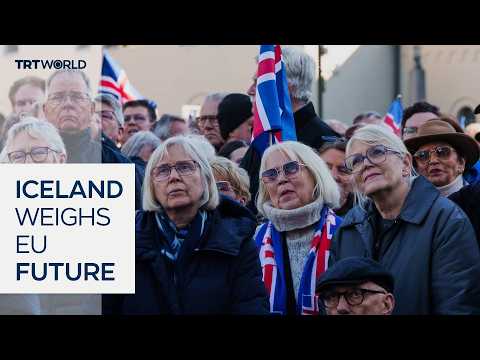
- Icelanders are voting in a referendum to decide whether to resume talks on joining the European Union, 13 years after they were broken off.
- The latest opinion poll indicates the No campaign is leading with 51.6% compared to Yes at 48.4%.
- Prime Minister Kristrún Frostadóttir's government had intended to hold a referendum, but turbulent international affairs prompted her to bring it forward.
- More than one in five voters had already cast their ballots in early voting before Saturday, according to Iceland's public broadcaster RUV.
- Voting is scheduled from 09:00 to 22:00 GMT on Saturday, with results expected in the early hours of Sunday.
- Iceland's application to join the EU was well advanced when it put talks on hold in 2013, and European Commission officials have indicated that talks could be finalized in one or two years.
- In 2009, Reykjavik started accession talks after the 2008 financial crisis, halting them in 2013.
- The debate surrounding the referendum has focused on sovereignty, fishing, and farming issues.
- Sovereignty has been a crucial issue in the pre-referendum debate, as Iceland fought hard to become fully independent from Denmark in 1944.
- The No campaign fears losing control over Iceland's prized fishing grounds under the EU's Common Fisheries Policy.
Icelanders are participating in a crucial referendum to determine whether to resume EU accession talks, a decision that could reshape the nation’s future. With the No campaign leading at 51.6%, the debate is heavily influenced by concerns over sovereignty, fishing, and farming.12810
Prime Minister Kristrún Frostadóttir has framed the potential EU membership as a “unique opportunity” for Iceland, especially in light of shifting global dynamics. She argues that joining the EU could enhance Iceland's security amidst unpredictable geopolitical shifts, particularly from the US and China.3
However, many Icelanders are apprehensive. Farmers like Davíð express fears that EU regulations could hinder their progress and profitability. He notes, “A yes win would lead to years of negotiations... the uncertainty would put a halt to all the progress and the momentum in farming.” Similarly, Jóhannsdóttir, a future farm owner, believes negotiations could slow down development and increase costs.
The referendum, which runs from 09:00 to 22:00 GMT, has seen significant early voter turnout, with over one in five casting ballots before the official day. As Iceland weighs its future, the outcome remains uncertain, with young voters like Saga Gautadóttir contemplating their choices amidst the polarized debate.5
The stakes are high for Iceland, a nation of under 400,000 people, as it navigates the complexities of EU membership while balancing national interests and global integration.
“The No campaign, led by Guðrún Hafsteinsdóttir, argues EU membership would hand decision-making on fisheries and agriculture to Brussels, while Yes campaigners, including PM Kristrún Frostadóttir, call it a 'unique opportunity' for security and economic stability. A Yes vote would only start negotiations, with a second referendum needed for final approval.”
 BBC
BBC The Guardian