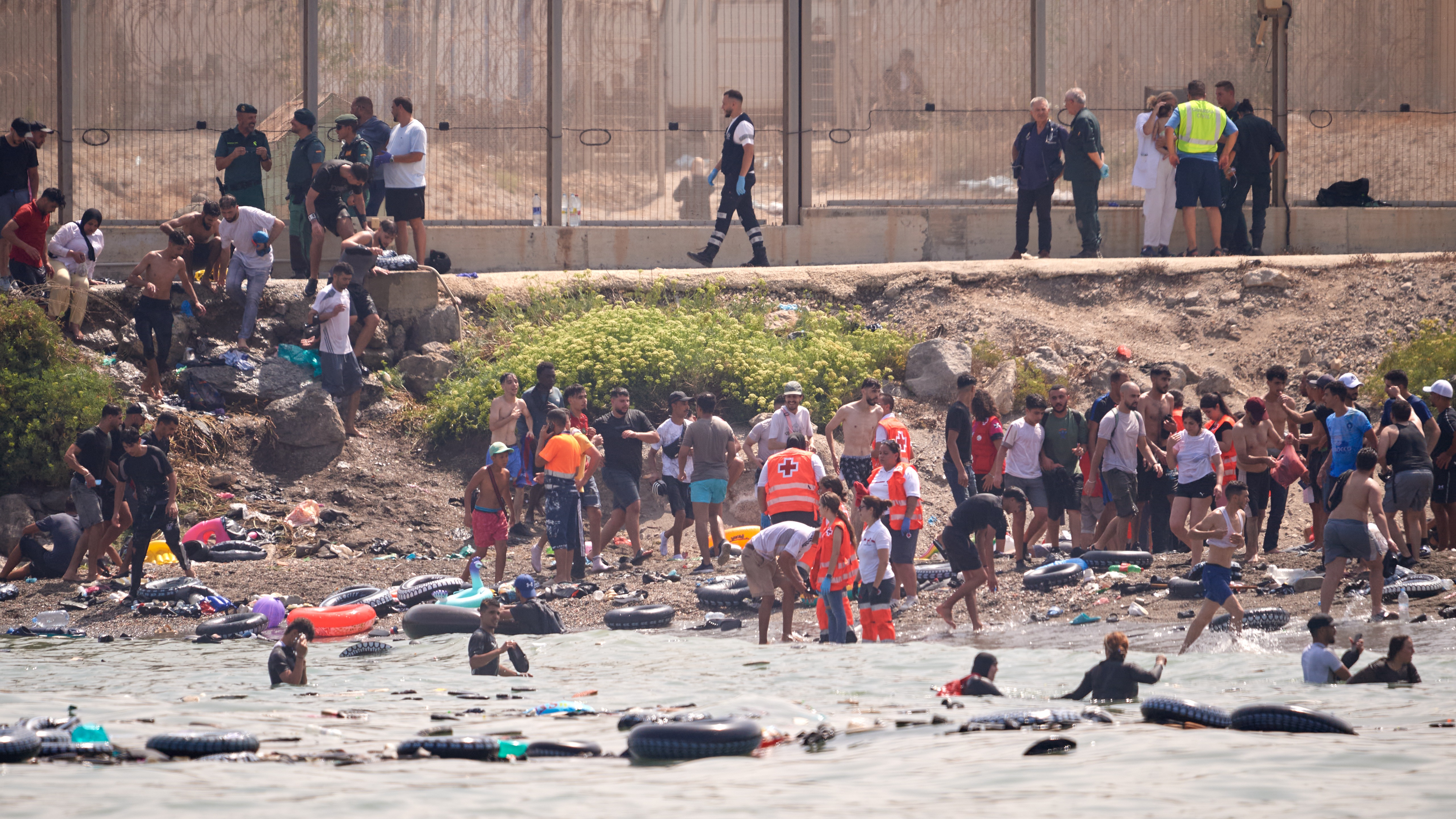
- At least nine people have died during the crossings, in which people have mainly tried to reach the enclave by sea.
- Spain is deploying its military to restore order at its border with Morocco at Ceuta after thousands of migrants entered the tiny Spanish territory on Thursday.
- Local authorities in Ceuta had asked the central government in Madrid for reinforcements to manage a border crisis that had been building up before boiling over on Thursday with large crowds of people breaching the border fence.
- Thousands of migrants have entered Ceuta in recent days, overwhelming security personnel.
- Spain’s government said on Thursday evening it would send the Armed Forces to help the Civil Guard 'maintain security in the city of Ceuta'.
- 'The situation is absolute chaos,' said Rachid Sbihi, head of the association that represents Spain's Civil Guard officers in Ceuta, who police the border.
- Achraf Maimouni, a member of the Moroccan Association for Human Rights in northern Morocco, described the situation as 'exceptional'.
- Spain’s Interior Ministry said the Moroccan government was 'closely cooperating' to handle the situation, saying that Moroccan police are stopping 'numerous people' trying to cross the border.
- Both countries agreed to work together 'for the return, as soon as possible, of all the people who entered Ceuta illegally'.
- Spanish Prime Minister Pedro Sanchez posted on X: 'The Government of Spain is fully committed to providing an immediate response to the situation in Ceuta.'
At least nine people have died during perilous crossings from Morocco to Ceuta, where thousands of migrants have overwhelmed local security forces. In response, Spain is deploying military personnel to assist the Civil Guard in maintaining order in the enclave.1
Local authorities in Ceuta had previously requested reinforcements from Madrid as the border crisis escalated. On Thursday, large crowds breached the border fence, prompting the Spanish government to act. Spanish Prime Minister Pedro Sanchez stated, 'The Government of Spain is fully committed to providing an immediate response to the situation in Ceuta.'310
Rachid Sbihi, head of the association representing Spain's Civil Guard officers in Ceuta, described the situation as 'absolute chaos'. The influx of migrants has led to overwhelmed reception centers, with hundreds sleeping on the streets. Juan Jesús Vivas, head of Ceuta's regional government, warned of the dire conditions as more than 1,500 migrants entered the territory in the past week alone.
The Moroccan government is reportedly cooperating with Spain to manage the crisis, with both countries agreeing to work together for the return of those who entered Ceuta illegally. Achraf Maimouni, from the Moroccan Association for Human Rights, called the situation 'exceptional' as the humanitarian crisis unfolds.7
“Spanish Prime Minister Pedro Sanchez stated, 'The Government of Spain is fully committed to providing an immediate response to the situation in Ceuta.' Meanwhile, Rachid Sbihi, head of the Civil Guard officers' association, described the situation as 'absolute chaos' as local authorities seek reinforcements.”






