
- Hundreds of migrants have entered Spain's north African territory Ceuta from Morocco by swimming across the border in recent days.
- In the past few days, more than 1,500 migrants, both adults and minors, have arrived in Ceuta by sea.
- Ceuta's reception centres are overwhelmed, with no room left for new arrivals, as the number of people entering exceeds 200 a day.
- Facilities for unaccompanied minors are operating at 2,400 percent capacity, highlighting the severity of the situation.
- Ceuta officials have requested the Spanish government to declare a national emergency and send the army to assist with border security.
- Spanish Prime Minister Pedro Sanchez has pledged an immediate response to the crisis, mobilizing necessary resources.
- Spain's interior ministry is coordinating efforts to respond quickly to the situation in Ceuta.
- Interior Minister Fernando Grande-Marlaska is scheduled to visit Ceuta to monitor the situation and meet with local officials.
- Moroccan security forces are reportedly preventing many migrants from reaching Ceuta, indicating a complex cross-border dynamic.
- Spain's Supreme Court recently ruled that migrants intercepted at sea cannot be summarily returned under the enclaves' special border-rejection regime.
Ceuta is facing a severe humanitarian crisis as over 1,500 migrants have arrived in just days, many swimming from Morocco. Local officials warn that reception centers are overwhelmed, operating at 2,400 percent capacity, with calls for national emergency assistance and military support.
The president of Ceuta, Juan Jesus Vivas, stated, "We cannot face this pressure alone — pressure that has resulted in the arrival of between 1,500 and 2,000 people in just 10 days, equivalent to 2% of our population." He urged the Spanish government to declare a national emergency and deploy the army to secure the border.
Spain's Interior Minister, Fernando Grande-Marlaska, is set to visit Ceuta to assess the situation, while the Spanish Prime Minister, Pedro Sanchez, has pledged an "immediate response" to the crisis. Sanchez emphasized the government's commitment to mobilizing resources and collaborating with Moroccan authorities to restore order.
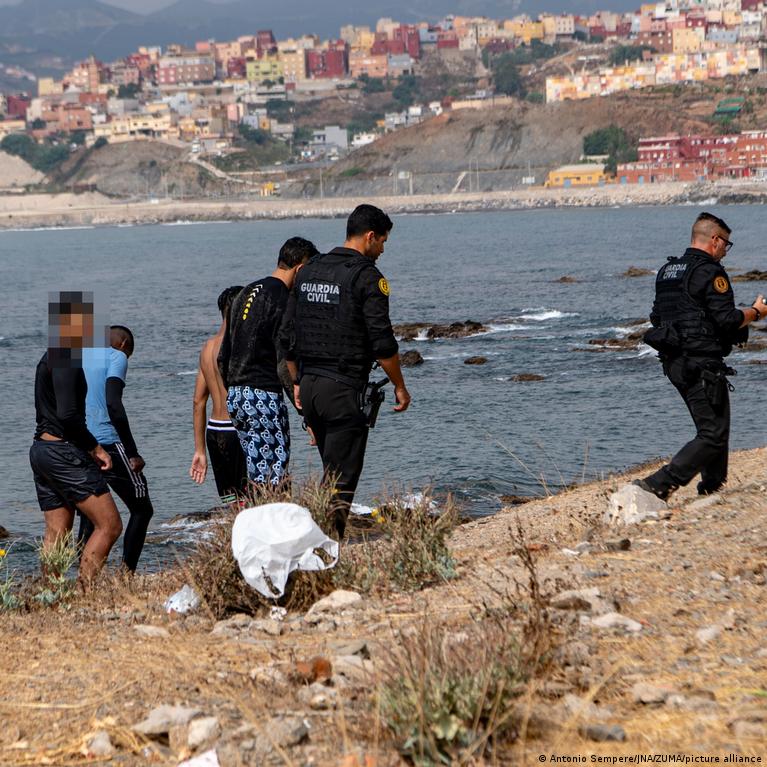
The influx of migrants coincides with a ruling from Spain's Supreme Court, which prohibits the summary return of migrants intercepted at sea. This legal backdrop complicates the situation further, as local officials report that facilities are saturated and unable to accommodate the growing number of arrivals.10
As the crisis unfolds, the Moroccan government is reportedly working closely with Spain to manage the situation, with security forces actively preventing further crossings.
“Ceuta's president described the situation as a "total humanitarian and social emergency," with reception centers operating at 2,400 percent capacity. Prime Minister Pedro Sanchez pledged an immediate response, mobilizing resources and coordinating with Moroccan authorities to address the crisis.”
 DW.com



