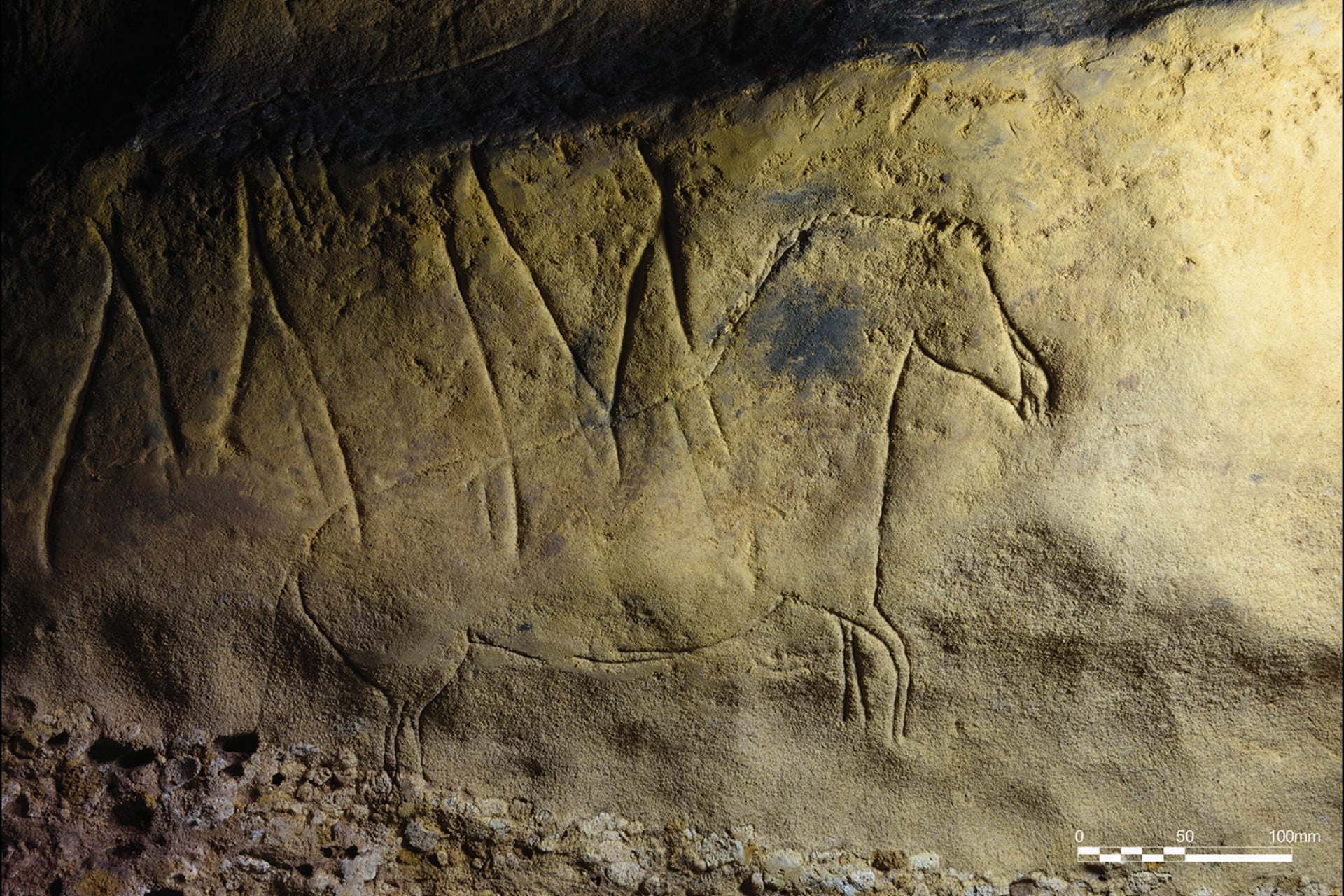
- Researchers have identified 280 Ice Age engravings inside Cova de la Font Major, a cave in Catalonia, Spain, which people have been visiting since the 12th century.
- The markings include 55 animal figures along with a wide range of abstract shapes and signs carved into the walls.
- The engravings were dated to at least 19,000 years old, from the Upper Paleolithic.
- The team published the results in the journal Antiquity after studying the engraved surfaces across the cave.
- This discovery challenges previous assumptions about the region's Ice Age art and population.
- Fewer than 10% of rock art in the region has more than 20 drawings of animals, and 75% has no more than 5.
- Experts had long believed the cave walls were unsuitable for engravings, and nobody had found any until archaeologists identified the carvings in 2019.
- Before this study, Catalonia had only two known Ice Age figures in the whole region, which made the area look empty.
- Scientists now treat the cave as evidence of dense settlement in a region once viewed as thinly occupied by Ice Age people.
- Co-author Míriam Salas-Altès says north-eastern Iberia holds first-rate sites, and the team calls for systematic rock art research across Catalonia.


Researchers have identified 280 Ice Age engravings inside Cova de la Font Major, a cave in Catalonia, Spain, which has been visited since the 12th century. The engravings include 55 animal figures such as horses, deer, and bovids, along with geometric shapes and lines.12
Dating the engravings has proven challenging, but experts have narrowed their age to at least 19,000 years, placing them in the Upper Paleolithic period during the last glacial phase. Josep Maria Vergès, a co-author from the Catalan Institute of Human Paleoecology and Social Evolution, expressed disbelief at the discovery, noting that thousands of visitors had walked past these engravings without noticing them.
“At the moment of discovery, I experienced a mixture of excitement at encountering something both unexpected and extraordinary and profound disbelief,” Vergès stated. The engravings were obscured by modern graffiti, with some visitors even scratching their names over the ancient art.

The significance of this find is underscored by the fact that fewer than 10% of rock art in the region contains more than 20 animal drawings, while 75% have five or fewer. This discovery enriches the understanding of Ice Age art in Iberia, revealing a distinct artistic tradition in north-eastern Iberia that differs from the well-known Franco-Cantabrian region.6
“Contrary to what was previously thought, north-eastern Iberia holds first-rate Palaeolithic rock art sites,” the team concluded, emphasizing the importance of this new body of rock art in characterizing Mediterranean graphic traditions.
“The cave, a tourist attraction since 1993, has drawn thousands of visitors who unknowingly passed the art; even an experienced guide missed the horse until it was pointed out. The discovery challenges the region's sparse Ice Age record, suggesting denser settlement than previously assumed.”
GizmodoArchaeology News Online Magazine



