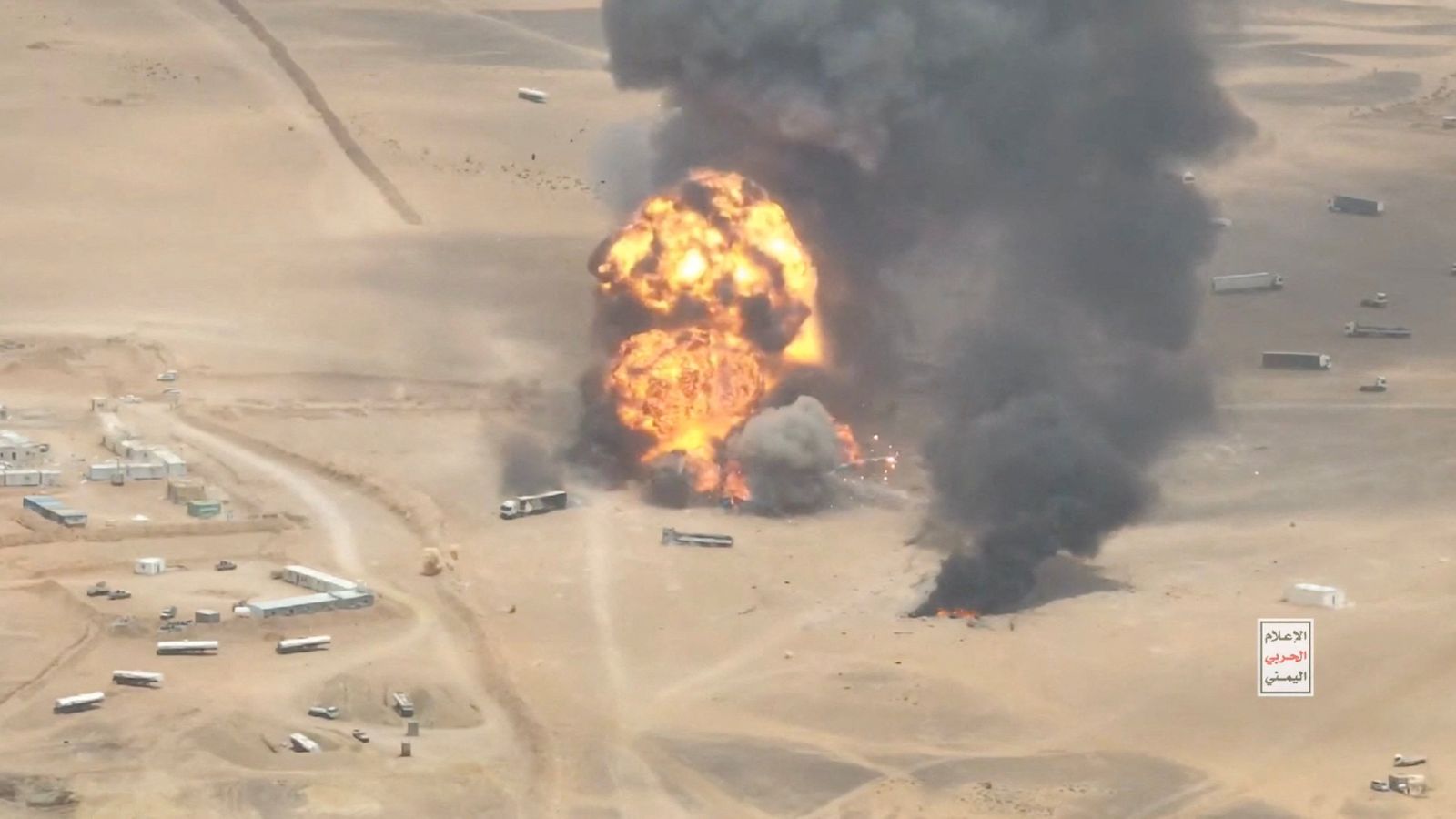
- Houthis attacked Saudi Arabia-linked trucks carrying military equipment with ballistic missiles at the Al-Wadiah border crossing, according to Houthi Media.
- Saudi Arabia threatened to retaliate after Houthi missiles set oil facilities ablaze and injured dozens, marking the rebels' heaviest attack in years.
- Saudi authorities confirmed that multiple energy facilities and installations in the south were attacked, vowing a firm response.
- Houthis claimed to have targeted Saudi energy infrastructure operated by Aramco using drones and ballistic missiles, describing it as a broad operation.
- Saudi foreign minister Prince Faisal condemned the attacks, stating that the kingdom will never hesitate to defend itself.
- Yemen's internationally recognised government launched counteroffensives against Houthi-held positions across several provinces amid escalating violence.
- WHO reported at least 728 killed or wounded in Yemen since August 23, with 21,000 displaced from Taiz due to the ongoing conflict.
- Houthis declared a naval blockade against Riyadh in July, which has led to increased tensions and attacks on Saudi vessels.
- The flare-up in violence follows the collapse of a four-year truce in July, coinciding with rising tensions between the U.S. and Iran.
- Yemen's government forces have reported significant advances against the Houthis in several provinces, including al-Jawf and Taiz.
- Analysts suggest the conflict is no longer merely domestic, as the Houthis' actions are linked to broader regional dynamics involving Iran.
Yemen's Iran-backed Houthis have intensified their military campaign against Saudi Arabia, launching ballistic missiles that targeted trucks carrying military equipment at the Al-Wadiah border crossing. The attacks, described as the heaviest in years, resulted in 73 injuries and temporary shutdowns of oil facilities, according to Saudi authorities.
The Houthis claimed responsibility for the strikes, stating they were aimed at energy sites belonging to Saudi oil giant Aramco. Footage from the scene showed a missile strike igniting a series of explosions, with soldiers fleeing amid the chaos. The escalation follows the collapse of a UN-brokered truce in July, which had halted large-scale fighting for nearly a year.4
Saudi Arabia's Energy Ministry confirmed that multiple energy facilities in the southern provinces were hit, prompting a firm response from Riyadh. A foreign ministry statement emphasized the kingdom's commitment to defend its sovereignty and called for an end to Houthi attacks on Red Sea shipping.

The renewed hostilities are part of a broader conflict involving the Houthis and Yemen's internationally recognized government, which is launching counteroffensives against Houthi positions. The World Health Organization reported that at least 728 people have been killed or wounded in Yemen since late August, highlighting the humanitarian crisis exacerbated by the ongoing violence.
Analysts suggest that the Houthis' military strategy is increasingly linked to control over the Bab al-Mandeb Strait, a critical maritime route, as they seek to exert pressure on shipping traffic in the Red Sea. The situation remains fluid, with expectations of a negotiated settlement in the long term.11
“The attacks wounded at least 73 people and caused temporary shutdowns at oil facilities, including the Jazan refinery with 400,000 barrels per day capacity. The escalation also threatens the Bab al-Mandeb Strait, where Saudi crude exports have surged eightfold since mid-July.”