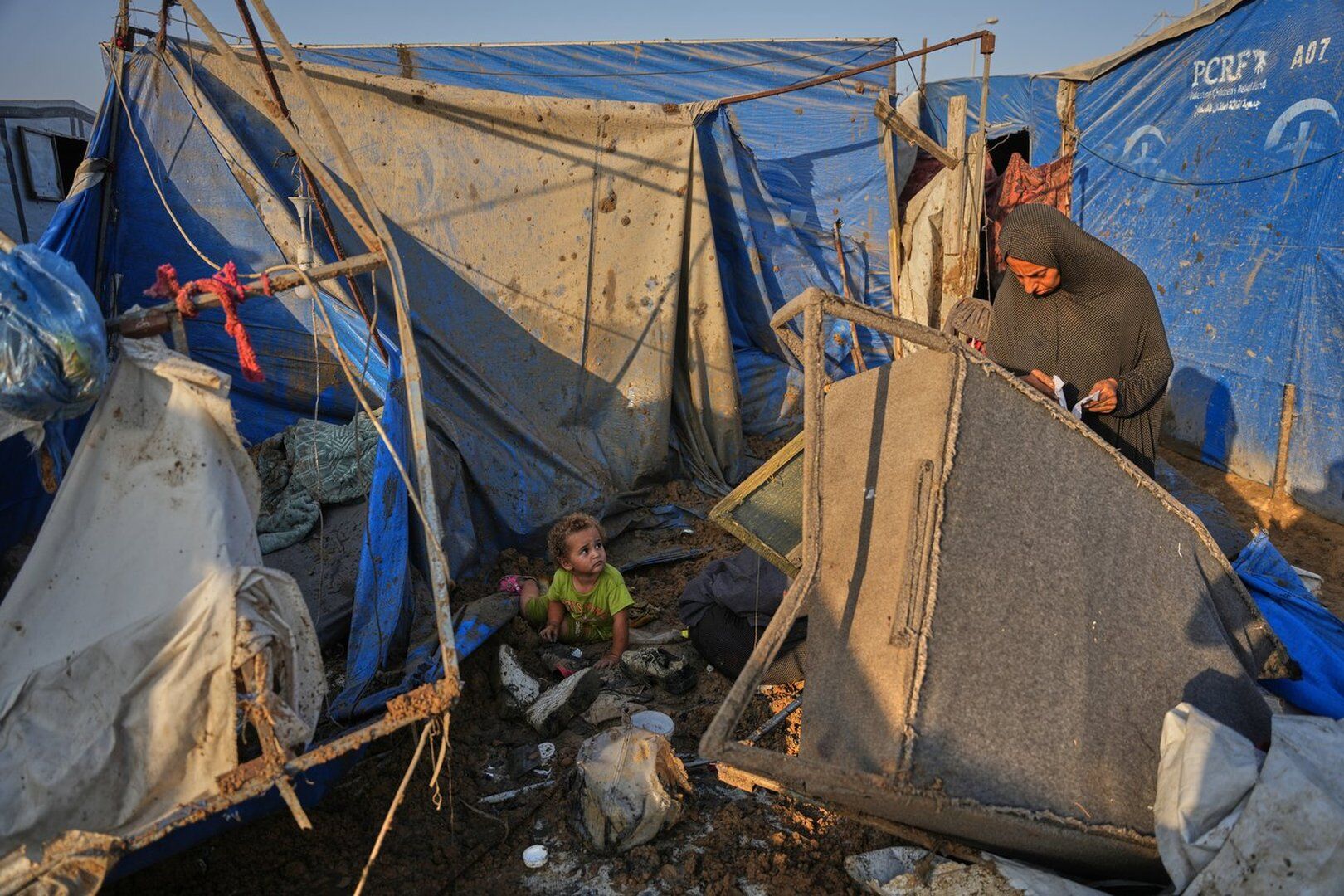
- Donald Trump announced that Hamas had agreed to disarm, providing a small sign of hope for Palestinians in Gaza that Israel's attacks might end, although this announcement clashes with the reality on the ground where few steps have been taken to advance the ceasefire agreement.
- The ceasefire agreement called for the gradual withdrawal of Israeli troops, the creation of an international stabilization force, and a program to decommission weapons held by Hamas, but negotiations have stalled as each side accused the other of violations.
- The conflict began when Hamas-led militants attacked southern Israel on Oct. 7, 2023, killing around 1,200 people and taking 251 hostages, while Israel's retaliatory offensive has killed more than 73,300 people according to the Gaza Health Ministry.
- The road map announced by Trump and confirmed by Hamas specifies the weapons to be handed over to a new technocratic government, states that Israel will not be involved in decommissioning Hamas weapons, and calls for Israel to halt all military operations in Gaza.
- Some residents in Gaza remain skeptical about the disarmament, with displaced Palestinian Ayman Ahmed expressing doubt that Hamas will give up its arms, stating, “They don’t care about Palestinians’ lives.”
- Other Palestinians believe that due to the high death toll and ongoing attacks, Israel will refuse to make concessions, with Ghazal Astal describing Gaza as an “indescribable battlefield.”
- Israel has not publicly commented on the road map, but officials indicated that the document does not align with the country’s interests and reiterated that Israel would not withdraw from the Yellow Line in Gaza.
- Displaced Palestinians dream of returning home, with Anas Nakla stating, “It doesn’t exist anymore, but we can return and rebuild.”
- Mohamed Hamad, who had to leave his home in northern Gaza, hopes that the U.S.-backed road map will pressure Israel to allow some returns, believing that even a small number of returns would give hope to others.
U.S. President Donald Trump announced that Hamas has agreed to disarm, a move that many Palestinians in Gaza view as a potential step towards peace. However, the reality on the ground remains grim, with ongoing violence and a lack of trust between the parties involved.12
The war began on October 7, 2023, when Hamas militants attacked southern Israel, resulting in approximately 1,200 Israeli deaths and the abduction of 251 hostages. In retaliation, Israel's offensive has led to over 73,300 Palestinian deaths, according to the Gaza Health Ministry.56
Trump's road map outlines a gradual withdrawal of Israeli troops and a program for decommissioning Hamas' weapons, but negotiations have stalled as both sides accuse each other of ceasefire violations. Hamas continues to hold onto its weapons, while Israeli forces remain entrenched in Gaza.3478
Many Palestinians express skepticism about the disarmament agreement. Ayman Ahmed, a displaced resident, stated, “This is enough. We need improvement in our lives,” while Abdel Moneim Aboul-Roos, a tuk-tuk driver, lamented, “I don’t care about any of it as long as there is no food or medicine.”
Despite the bleak outlook, some Palestinians like Mohamed Hamad hold onto hope that the U.S.-backed road map could pressure Israel to withdraw from some areas, allowing them to return home. “It will give hope to the rest that someday they may also return,” he said.
“The road map, confirmed by Hamas, hands weapons over to a new technocratic government and says Israel will not be involved in decommissioning them, though Israeli officials signaled the document does not align with their interests. Displaced Gazan Anas Nakla said his destroyed home 'doesn't exist anymore,' but 'we can return and rebuild.'”






