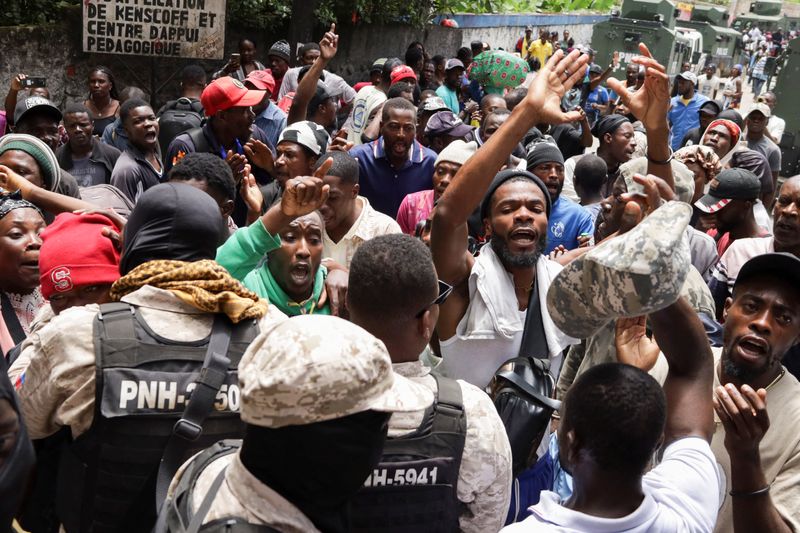
- Nearly 200,000 people were forcibly returned to Haiti in the first eight months of this year, a U.N. official told an emergency meeting of the Security Council on Friday, days after a brutal gang attack killed nearly 50 people in a town near the capital.
- The gang attack in Kenscoff on Sunday night resulted in the deaths of 47 people, including five children, with reports of houses being set on fire and people attacked inside a church.
- Days after the attack, Haiti received its first U.S. deportation flight since the Trump administration won a legal battle for around 350,000 Haitians.
- Another flight arrived on Thursday with migrants from the U.S. and the Bahamas.
- The Security Council will vote on renewing the mandate of the Gang Suppression Force (GSF) at the end of September.
- Haitian authorities first requested foreign military assistance in 2022, but this was slow to materialize.
- A year ago, the UN mandated the Gang Suppression Force (GSF) to deploy, which aims to reach a capacity of 5,500 troops by fall this year.
- Diplomats have expressed concern over limited international action to prevent gang massacres, emphasizing the need to rapidly scale up the deployment of the U.N.-backed multinational force.
- U.S. representative Jennifer Locetta called on the Security Council to renew the GSF mandate, stating that the force's mission is crucial for addressing the violence in Haiti.
- A representative for the Haitian government indicated that Chad, Mongolia, and Ivory Coast had agreed to support the GSF, with ongoing efforts for similar agreements with other countries.
Haiti has faced a staggering influx of nearly 200,000 forced deportations this year, according to a U.N. official, marking an increase of at least 20,000 compared to the same period last year. This alarming statistic comes in the wake of a brutal gang attack that left 47 people dead in Kenscoff, a community near Port-au-Prince.2
The U.N. Security Council convened to discuss the escalating violence, with acting assistant secretary-general for humanitarian affairs, Indrika Ratwatte, emphasizing the urgent need for enhanced international security support. Carlos Ruiz, head of the U.N. Integrated Office in Haiti (BINUH), warned that without improved security, preparations for the country's first elections in a decade remain “severely constrained and vulnerable to setbacks.”5
The gang attack, which occurred shortly after the U.S. resumed deportation flights to Haiti, highlighted the dire situation. Ruiz noted that among the victims were three boys and two girls, with many fleeing to a church for safety. “This latest heartbreaking episode is a stark reminder of the urgent need to further strengthen international security support for Haiti,” he stated.
Diplomats have called for a rapid scaling up of the U.N.-backed Gang Suppression Force (GSF), which aims to reach a capacity of 5,500 troops by fall. The Security Council is set to vote on renewing the force's mandate at the end of September, with U.S. representative Jennifer Locetta urging for its continuation, stating, “The GSF was not created to issue statements from within a compound wall or spend our money while Haiti suffers.”78910
“The attack in Kenscoff killed 47 people, including five children, with houses set on fire and escapees attacked inside a church. The UN-backed Gang Suppression Force aims to reach 5,500 troops by fall, and the Security Council will vote on renewing its mandate at the end of September.”

 KSL News