- A glacier collapse on Wednesday sent a surge of rock, ice, mud and debris through Himalayan river systems.
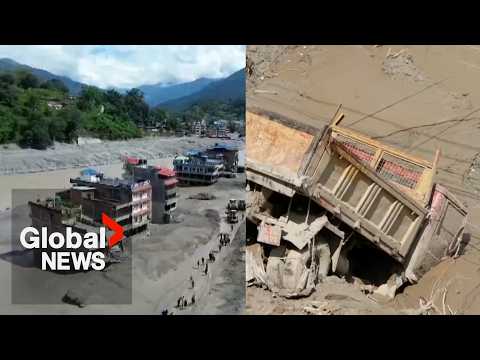
- A flash flood swept through the Nepal-Tibet border area, destroying roads, buildings, and infrastructure at the Gyirong checkpoint.
- A team of 21 Chinese rescuers and a search-and-rescue dog reached the checkpoint on Friday after crossing mountains and valleys.
- Rescue operations were briefly suspended on Friday after floodwaters caused a lake to overflow into the Lhende Khola and Trishuli rivers.
- Chinese and Nepali teams withdrew temporarily before resuming operations once the immediate threat eased.
- Nepal is monitoring two barrier lakes upstream, with officials warning that flooding could continue until they drain fully.
- At the checkpoint, rescuers found 'nothing but ruins' as they surveyed the destruction.
- The death toll has risen to at least 579 in Nepal and seven in Tibet, with many more missing.
- The number of missing people has risen to 1,924 in Nepal, while at least 558 are reported missing in Tibet's Gyirong County.
- The disaster has affected more than 90,000 people, according to the Red Cross.
- Dramatic surveillance footage showed torrents of water and debris engulfing buildings and forcing people to flee.
- Officials have warned that the region has more than 100 glacial lakes that could pose further risks.
- President Xi Jinping has called for closer monitoring of glacial lakes and landslide risks as rescue efforts continue.
A glacier collapse on Wednesday triggered a catastrophic mudslide that devastated the Gyirong port checkpoint on the Nepal-Tibet border, leading to significant loss of life and infrastructure.1
Rescuers, comprising a team of 21 and a search dog, reached the site to find “nothing but ruins”, as reported by a rescue worker, Zou Mingqi, who described the area as devoid of roads, surrounded by “virgin forest and sheer cliffs.”
The disaster has resulted in at least 586 fatalities, with 1,924 people missing in Nepal and 558 in Tibet, many of whom are foreign pilgrims heading to Mount Kailash. The Red Cross estimates that over 90,000 individuals have been affected by the calamity.
Dramatic footage captured at the checkpoint showed torrents of water and debris engulfing buildings, prompting immediate evacuations. Rescue operations faced interruptions due to rising floodwaters, but resumed once the threat subsided.4
Authorities in Nepal are closely monitoring two barrier lakes upstream, warning that flooding risks persist until they fully drain. Satellite images indicate one lake is expanding, while experts caution that the region's numerous glacial lakes could pose additional hazards.6
In response to the disaster, President Xi Jinping has called for enhanced monitoring of glacial lakes and landslide risks as rescue efforts continue.13
“At least 579 people have died in Nepal and seven in Tibet, with 1,924 missing in Nepal and 558 in Tibet's Gyirong County, including 540 foreigners. Nepal is monitoring two barrier lakes upstream, and Chinese experts warn of over 100 glacial lakes that could pose further risks.”



 News18
 The Guardian