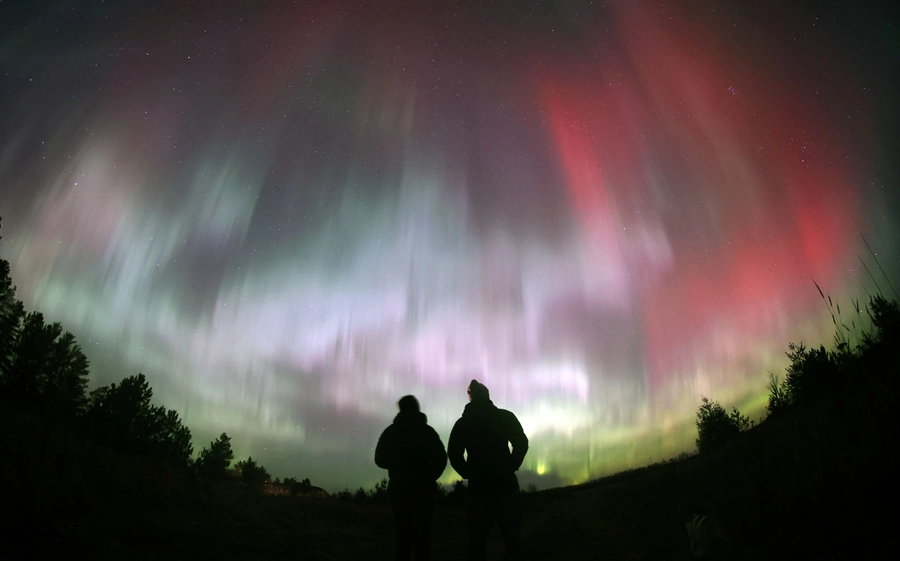
Geomagnetic storms forecasted from multiple CMEs; potential northern lights displays tonight, June 5.

Multiple coronal mass ejections (CMEs) are expected to trigger geomagnetic storms, reaching G3 levels. Skywatchers may see the northern lights tonight, with conditions possibly extending further south.

Sources:
NOAA Space Weather Prediction Center (.gov)Forbes+1
Trending 57m ago
Tab background
Sources: NOAA Space Weather Prediction Center (.gov)Sky & TelescopeForbes
Geomagnetic storms resulting from multiple coronal mass ejections (CMEs) are expected to affect Earth on June 5, with forecasts suggesting possible G3 storm levels. NOAA's Space Weather Prediction Center predicts the first waves of CMEs to arrive by mid-afternoon on June 4, continuing overnight into June 5.

Should forecasts hold, skywatchers could see northern lights as far south as the central United States, with the best visibility in northern-tier states such as Washington, New York, and Michigan. Observers in these regions might enjoy a spectacular show, with auroras potentially reaching *zenith heights*.

The geomagnetic field is anticipated to shift rapidly from quiet to active, with conditions remaining elevated throughout the multi-CME event. NOAA's forecasts indicate G2 (Moderate) and G3 (Strong) conditions, while isolated G4 (Severe) storming may also occur, intensifying the likelihood of magnificent auroras across broader regions, including portions of Oregon and Pennsylvania.

Despite earlier forecasts, where expectations were high for widespread aurora displays, some reports indicated the storm did not produce extensive visible phenomena in North America. Nonetheless, there remains a chance for northern light displays tonight, June 5, as geomagnetic conditions fluctuate. 

Over the course of this celestial event, observers and space weather enthusiasts continue to monitor the situation closely, hoping for a vibrant display in the night sky.
Sources: NOAA Space Weather Prediction Center (.gov)Sky & Telescope
Geomagnetic storms anticipated due to multiple coronal mass ejections (CMEs) could illuminate northern skies on June 5, with NOAA predicting G3-level storms. Observers as far south as central U.S. may witness the northern lights, especially in northern states, where displays may reach zenith heights.
Section 1 background
The Headline

Geomagnetic storm watch continues; northern lights possible

Key Facts
  • The current forecast calls for combined CME arrival around mid-afternoon EDT of June 4, with up to G3 levels possible afterwards.NOAA Space Weather Prediction Center (.gov)
  • CME passage would likely continue into the evening and possibly overnight hours of June 5.NOAA Space Weather Prediction Center (.gov)
  • NOAA's Space Weather Prediction Center expects a strong (G3 level) geomagnetic storm to arrive Thursday night, June 4th and continue through Friday morning.Sky & Telescope1
  • According to NOAA’s Space Weather Prediction Center, strong geomagnetic storms were likely and isolated severe storm conditions were possible during the peak of the event.Forbes
  • There is still a chance that the northern lights could make another appearance tonight — Friday, June 5 — before geomagnetic conditions gradually subside.Forbes
  • The best chances to see the northern lights remain across northern-tier states including Washington, Idaho, Montana, Wyoming, North Dakota, South Dakota, Minnesota, Wisconsin, Michigan, New York and Maine.Forbes
Section 2 background
Background Context

Context on ongoing geomagnetic conditions

Key Facts
  • Observers in the northern U.S. would see an exceptional show, with lights reaching as high as the zenith.Sky & Telescope1
  • If geomagnetic activity spikes considerably, the aurora zone could also extend farther south into Oregon, Nebraska, Iowa, Illinois, Indiana, Ohio, Pennsylvania, Massachusetts, Connecticut, Rhode Island, Vermont and New Hampshire.Forbes
  • CME events were anticipated to trigger multiple coronal mass ejections that could generate geomagnetic disturbances at levels reaching up to G4 (Severe) at peak times.Forbes
  • Geomagnetic field conditions are expected to escalate rapidly from quiet to active, reaching up to G3 (Strong) geomagnetic storming levels mid-to late on 04 June and persisting into 05 June in response to the multiple CME arrivals.Forbes
Article not found
CuriousCats.ai

Article

Source Citations