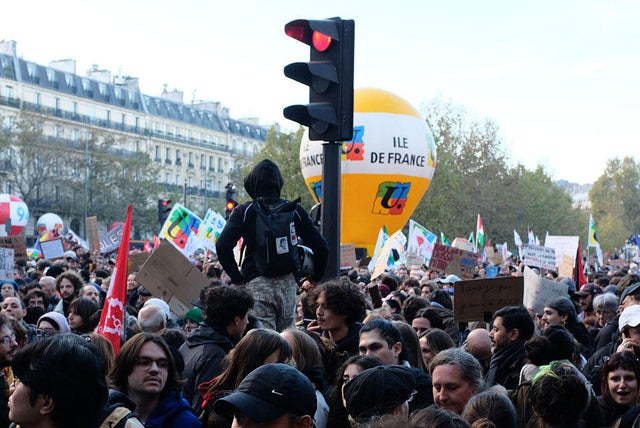
- Tens of thousands of government workers, teachers, transport employees and other union workers in France walked off the job Thursday to take part in massive economic protests, expressing frustration with low wages and the high cost of living.
- The General Confederation of Labour (GCL), one of France's major unions, said about 1.6 million people took to the streets, while France's Interior Ministry pegged the number much lower, at about 600,000.
- Thursday's rallies turned violent in some areas, ending with the use of tear gas by police; protesters torched a car in Lyon and burned objects on the streets of Paris.
- Sophie Binet, head of the GCL, explained the protests: "Our salaries do not allow us to live anymore," and criticized President Macron, saying "he thinks he knows everything alone," works "for the rich" and "not for the working people."
- Prime Minister Sébastien Lecornu called for a meeting with the unions on Monday, but another protest is already scheduled for the coming Saturday.
Tens of thousands of French workers, including teachers and transport employees, participated in massive protests against low wages and high living costs on Thursday. The General Confederation of Labour (GCL) reported 1.6 million participants, while the Interior Ministry estimated 600,000.12
"Our salaries do not allow us to live anymore," said Sophie Binet, head of GCL, highlighting the frustrations driving the protests. She criticized President Macron, stating, "Because he thinks he knows everything alone... he works for the rich, for the multinational and for the finance, not for the working people."56
The protests, which briefly shut down the Eiffel Tower, turned violent in some areas, with police using tear gas to disperse crowds. In Lyon, protesters torched a car, while in Paris, objects were set ablaze on the streets. Mayor Bally Bagayoko of Saint-Denis expressed that Macron is "incapable of bringing answers," as protesters demand action against growing inequalities. Another protest is already scheduled for Saturday, indicating ongoing unrest among the populace.34
The demonstrations reflect a broader discontent with the government's handling of economic issues, as many citizens feel increasingly marginalized in a society perceived as favoring the privileged.
“GCL head Sophie Binet said 'our salaries do not allow us to live anymore,' accusing Macron of working 'for the rich, not for the working people.' Prime Minister Sébastien Lecornu called for a union meeting Monday, but another protest is already set for Saturday.”


 CBS News