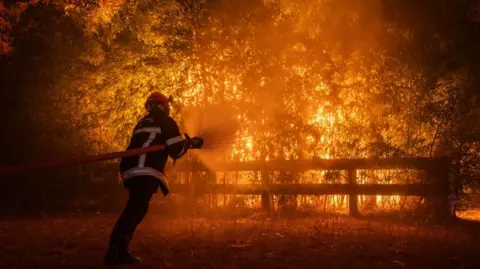
- Since late July, untamed fires in France’s Gironde department and across three provinces west of Spain’s Madrid have driven over 325,000 people from their homes.
- Governments in both nations have been escalating their responses.
- France has deployed about 1,000 firefighters, a military aircraft carrying 20,000 litres of retardant, and planes loaned by Croatia, Portugal, Czech Republic, and Slovakia.
- Spain has mobilised over 2,700 personnel, including a military emergency unit, plus planes from Greece, Italy, Portugal and Turkey through the EU’s civil-protection mechanism.
- For the first time on French soil, the Gironde fire generated a pyrocumulonimbus: a storm cloud born of the fire’s own superheated air plume, which cools, condenses ash-laden moisture, and triggers lightning that ignites new blazes, authorities said.
- The latest wildfire emergency extends beyond France and Spain; Italy evacuated hundreds of people from its Adriatic coast as separate fires swept through Puglia, while Scotland and other Mediterranean countries have also reported significant flare-ups.
Wildfires in France and Spain have led to the evacuation of over 325,000 people as governments ramp up firefighting efforts amid a severe heatwave.
The Gironde fire in France, which began on July 22, has forced the evacuation of the entire Arcachon Bay area, with flames dangerously close to Bordeaux.
By July 26, 220,000 people had been ordered to evacuate in France, while in Spain, nearly 89,000 people were displaced due to a fire that merged with another blaze in Madrid.
The fires have devastated approximately 69,500 hectares in France and 150,000 hectares in Spain since January, with the Avila-Madrid-Toledo fire alone damaging 77,000 hectares.

In response, France has deployed around 1,000 firefighters and military aircraft, while Spain has mobilized over 2,700 personnel and additional support from other EU countries.34
Both countries are grappling with the effects of Europe’s third summer heatwave, which has already caused around 1,000 excess deaths in France in June.
Notably, the Gironde fire has generated a pyrocumulonimbus, a storm cloud formed from the fire's heat, which can ignite new blazes.5
As the situation escalates, governments in both nations are intensifying their responses to combat the wildfires.
“France has deployed about 1,000 firefighters and military aircraft carrying 20,000 litres of retardant, while Spain has mobilised over 2,700 personnel, including a military emergency unit. For the first time on French soil, the Gironde fire generated a pyrocumulonimbus, a storm cloud that can ignite new blazes.”