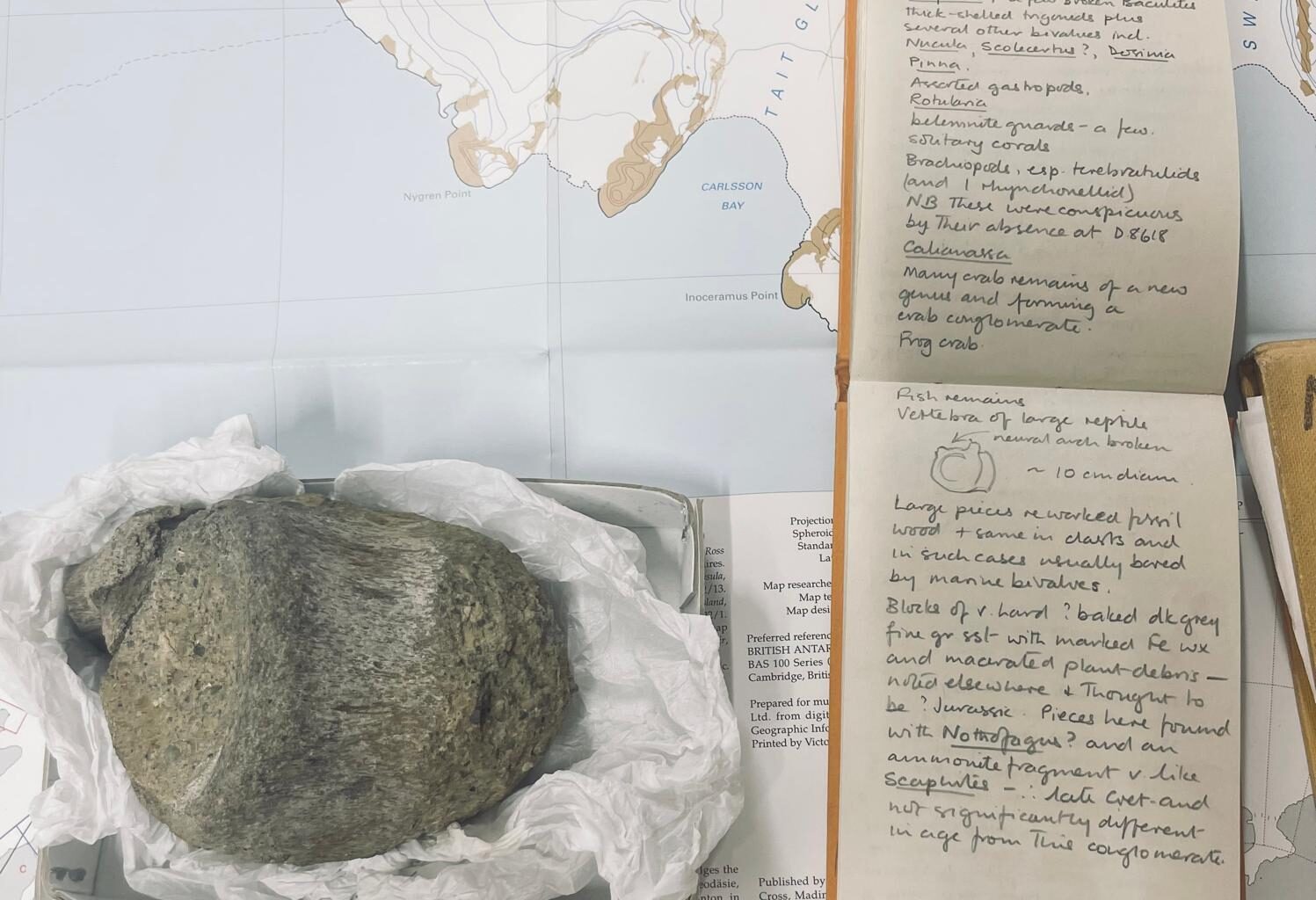
- First dinosaur fossil discovered on Antarctica has been identified as a titanosaur after lying ignored in a drawer for 40 years.
- The fossil was collected in 1985 during an expedition to James Ross Island.
- This fossil is only the second sauropod bone from the entire continent.
- The dinosaur was likely six to seven metres long, indicating it was either a juvenile or a dwarf species.
- The fossil's discovery shows that Antarctica was once covered in vegetation that supported plant-eating dinosaurs around 82 million years ago.
- When unearthed in 1985, scientists were unable to identify the fossil, leading to its storage in the geology collection of the British Antarctic Survey in Cambridge.
- The specimen's discovery was recorded in a field notebook alongside a sketch, noting it as potentially the vertebra of a large reptile.
- The fossil is from the Late Cretaceous period, specifically the Campanian, indicating its age and significance.
- The vertebra was found alongside bits of ammonite, further indicating the ancient ecosystem.
- Prof Barrett confirmed the fossil's distinctive shape as a vertebra from a four-legged herbivore with a long neck and tail.
A fantastically rare fossil ignored for 40 years has been identified as the first dinosaur bone discovered on Antarctica, a titanosaur vertebra collected in 1985 during an expedition to James Ross Island. Initially misidentified, it was stored in the British Antarctic Survey's geology collection until its recent classification.1237

The fossil, measuring around 10cm wide, suggests the dinosaur was approximately 23ft (7m) long, indicating it could be a juvenile or a dwarf species. Prof Barrett noted, “We know that these were really big animals, so they required lots of food, so we know there were a lot of things growing there for them to feed on.”
This discovery sheds light on the ancient ecosystem of Antarctica, revealing that it was once covered in vegetation that supported large herbivorous dinosaurs around 82 million years ago. The vertebra's distinctive shape confirmed it belonged to a four-legged herbivore with a long neck and tail, contributing to the understanding of the region's prehistoric life. Prof Barrett emphasized the significance of this find, stating that dinosaur fossils from Antarctica are “fantastically rare” and will enhance experts’ knowledge of the period.611

The fossil was originally recorded in a field notebook with a sketch, noting it as potentially the “vertebra of [a] large reptile.” Its identification marks a significant milestone in paleontological research in the region.
“A dinosaur fossil collected in 1985 has been identified as the first piece of dinosaur bone ever discovered on Antarctica. This significant find contributes to understanding the ancient ecosystem that existed on the continent around 82 million years ago.”





