 Nature
- Scientists have detected the "fingerprints" of a black hole's event horizon—the boundary from which nothing can escape—for the first time, according to research published Wednesday.
- The discovery was made by studying ripples in spacetime called gravitational waves that were created when two black holes violently smashed into each other.
- For the new research in Nature, an international team of researchers analyzed data from the strongest gravitational wave ever recorded, known as GW250114, detected by the LIGO observatory in January 2025.
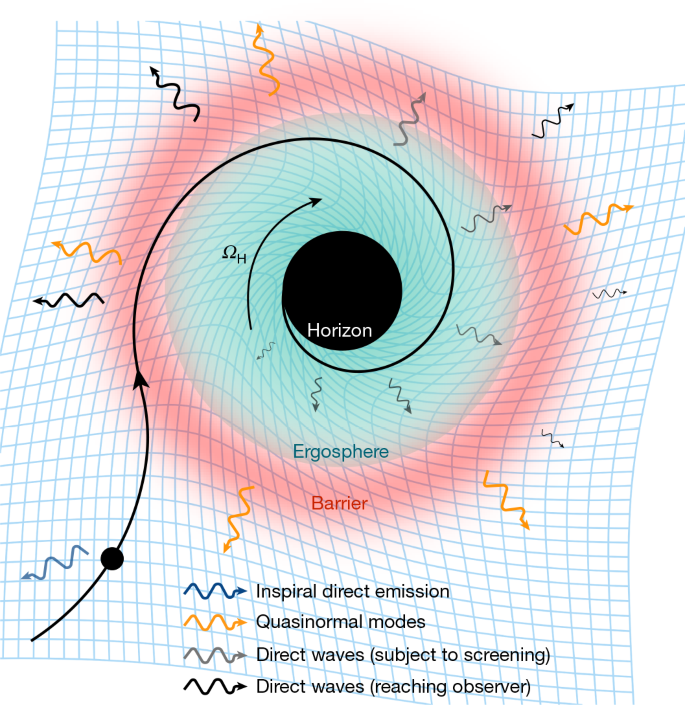
- The gravitational-wave component oscillates near 2 ' H, reflecting the horizon’s frame dragging, and decays at an increasing rate characterized by '.
- The measured properties of GW250114 are in full agreement with theoretical predictions for a Kerr black hole.
- These findings establish an observational channel to directly measure frame-dragging effects in black-hole ergospheres and explore (near-)horizon physics in dynamical, strong-gravity regimes.
- Sizheng Ma of the Perimeter Institute for Theoretical Physics stated, "This black hole horizon concept normally appears in science fiction," and added, "But now we are really able to touch the region around the horizon with gravitational data."
- The scientists emphasized that more research was needed to decipher what can be gleaned about event horizons using this method, but they did detect information about how black holes twist space around themselves as they rotate.
- Francesco Sannino, an Italian theoretical physicist, described the analysis as "compelling" but noted it needed to be checked by other researchers, stating it was "striking" that the scientists were able to show that gravitational waves carried the event horizon's "fingerprints."
Scientists have made a groundbreaking discovery by detecting the "fingerprints" of a black hole's event horizon for the first time. This significant finding was published in Nature and stems from the analysis of gravitational waves generated by the collision of two black holes, specifically the event known as GW250114, detected by the LIGO observatory in January 2025.135
The research reveals that the gravitational-wave component oscillates near 2 Ω H, reflecting the horizon’s frame dragging, and decays at an increasing rate characterized by κ, with additional screening from the black hole’s spacetime. These findings establish an observational channel to directly measure frame-dragging effects in black-hole ergospheres and explore (near-)horizon physics in dynamical, strong-gravity regimes.46

Lead study author Sizheng Ma noted, "This black hole horizon concept normally appears in science fiction, but now we are really able to touch the region around the horizon with gravitational data." The scientists emphasized the need for further research to fully understand the implications of their findings. Francesco Sannino, an Italian theoretical physicist, described the analysis as "compelling" but stressed it requires validation from other researchers. The ability to show that gravitational waves carry the event horizon's "fingerprints" is a striking advancement in astrophysics.781112
“Researchers have detected the 'fingerprints' of a black hole's event horizon for the first time, revealing significant insights into black hole physics. This discovery was made by analyzing gravitational waves from the strongest event recorded, GW250114.”




