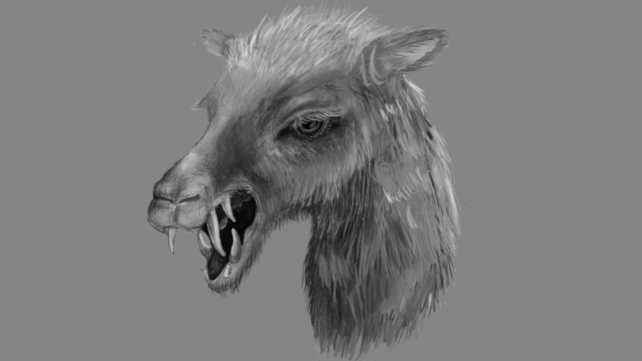
- Vampyrocamelus welshi has been identified as a new genus and species of ancient camel, featuring fang-like canines approximately 40 mm long.
- The fossils of Vampyrocamelus were collected in the early 20th century and have been stored in museum collections for about a century.
- Paleontologists reanalyzed tens of thousands of camelid specimens from Childs Frick's collection to update the camel family tree.
- The species is set to be described in a monograph published by the New Mexico Museum of Natural History and Science Bulletins.
- Vampyrocamelus lived approximately 10 to 13 million years ago, with its remains commonly found in Texas and Oklahoma, and occasionally in Nebraska.
- The defining feature of Vampyrocamelus is its enormous canines, which are significantly larger than those of any other known camelid.
- The skull of Vampyrocamelus resembles that of other camelids, but its fangs set it apart.
- There are few known bones beyond the skull, but some broken limb and foot bones appear similar to those of a related genus, Aepycamelus, which had a giraffe-like appearance.

Paleontologists have unveiled a new species, Vampyrocamelus welshi, dubbed the 'vampire camel,' from fossils that have been stored in museums for nearly a century.123678
The species was identified through a comprehensive reanalysis of camelid specimens from Childs Frick's collection, which included tens of thousands of bones.4
The fossils date back to 10 to 13 million years ago and are primarily found in Texas and Oklahoma, with some occurrences in Nebraska.
The defining characteristic of Vampyrocamelus is its fang-like canines, measuring approximately 40 millimeters (1.6 inches) long. According to researchers, "The canines are enormous compared to any other known camelid, with a long recurved tip, coming to a sharp terminal point in most specimens."
While its skull resembles that of other camelids, the rest of the skeleton remains largely unknown, with only a few broken limb and foot bones available for study.
Vampyrocamelus is thought to have lived similarly to a related genus, Aepycamelus, which had a giraffe-like appearance and could have grazed treetops with a neck reaching up to 3 meters (10 feet) high.9
The fangs may have served as a defense mechanism against predators, but researchers suggest they were likely used by males to compete for female attention.
Katherine Marriott, a paleontologist at the American Museum of Natural History, noted that "the males may have used the fangs to attract females, because the females did not have them." The study indicates that many bones previously attributed to Aepycamelus might actually belong to Vampyrocamelus, complicating the understanding of these ancient creatures.
“The fossils, part of Childs Frick's collection at the American Museum of Natural History, were reanalyzed among tens of thousands of camelid specimens. The fangs, about 40 millimeters long, were likely used by males to compete for females, as females lacked them.”
ScienceAlert