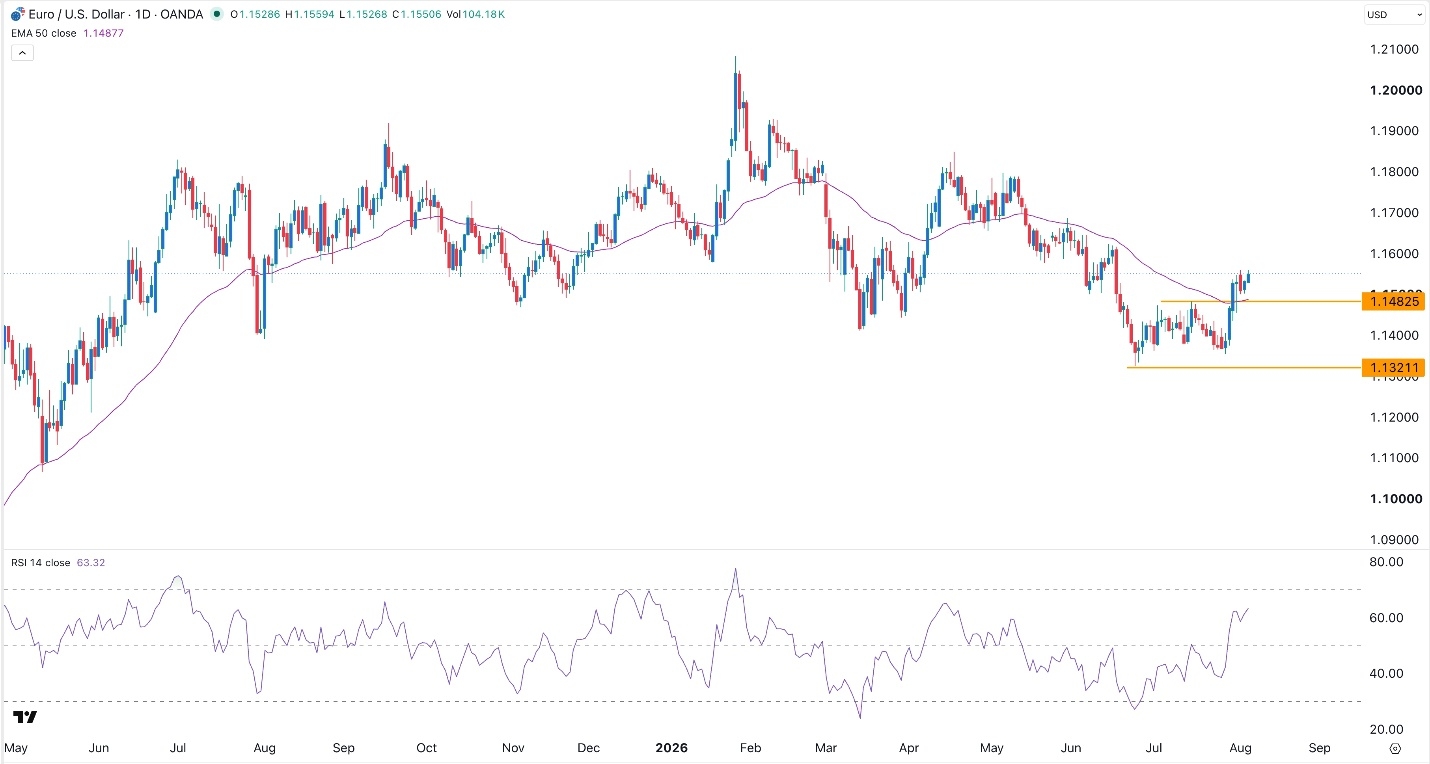
- The EUR/USD pair has broken above resistance at 1.1480 and the 50-day moving average, indicating a bullish trend.
- Currently, the EUR/USD has reached 1.1554, which is nearly 2% higher than its low of 1.1325 in June.
- Market attention is now on the upcoming BLS report and ongoing Middle East developments.
- In June, the EUR/USD fell to a low of 1.1325 before recovering.
- The Eurozone PMI increased from 49.4 in June to 51.7 in July, indicating economic growth.
- The ADP private payrolls report showed a decline to 44k jobs in July from 95k in June, below expectations.
The EUR/USD pair has broken higher, reaching 1.1555, a significant rebound from a low of 1.1325 in June. This surge follows strong Eurozone PMIs, with the services PMI at 54.6 and composite PMI at 54.5, indicating economic resilience.123478
The private nonfarm payrolls report from ADP showed a decline to 44k jobs in July, below the expected 68k, shifting focus to the upcoming Bureau of Labor Statistics report, which is anticipated to show job creation of over 57k.
Market sentiment is also influenced by the Middle East peace negotiations, with hopes for a resolution between the US and Iran, which could stabilize energy prices and further support the euro.
Technical analysis indicates that the EUR/USD has surpassed key resistance levels, including the 50-day Exponential Moving Average, confirming a bullish outlook. The pair's ability to hold above 1.1550 could lead to further gains, potentially testing the 100-day moving average.
As traders navigate these developments, the interplay between US economic data and geopolitical events in the Gulf will be crucial in determining the euro's trajectory moving forward.
“The pair's rally is supported by strong Eurozone PMI data, with composite PMI rising to 52 from 50, while ADP private payrolls slipped to 44k in July, below estimates. Traders now await Friday's BLS report, expected to show over 57k jobs added, and watch for a potential reopening of the Strait of Hormuz.”






