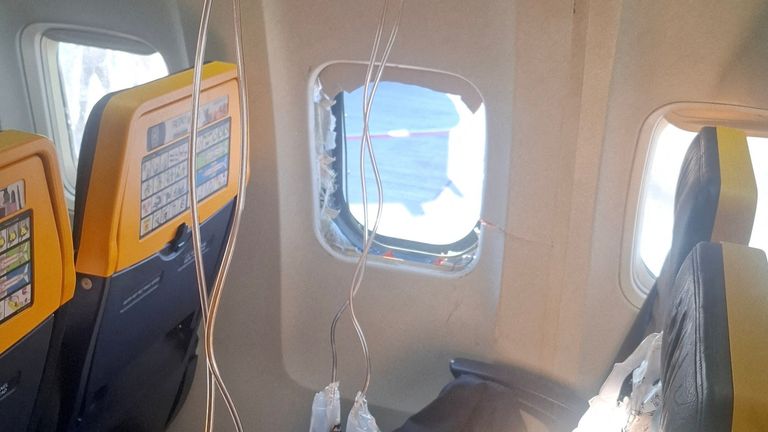
- Engine debris shattered a Ryanair window, pulling a passenger partially out of the aircraft, according to the NTSB.
- Passengers managed to pull the man back inside; he suffered neck and shoulder injuries and friction burns, and a doctor on board treated him as the aircraft returned to Thessaloniki.
- Investigators traced the damage to an area near the root of the blade, finding signs of high-amplitude fatigue caused by repeated stress.
- Investigators found feathers and bird remains in the engine, but the NTSB has not concluded a bird strike caused the blade failure; the engine had four suspected bird strikes in the prior year, and fan blades passed ultrasonic inspections in November 2025 and May 2026.
- Two teenage brothers, Deivi Delfín (15) and Winder (17), fled Venezuela after surviving two devastating earthquakes, only to be caught in another disaster in Colombia.
- The brothers' home in La Guaira, the area hardest hit by the twin quakes on 24 June, was destroyed, killing three family members including their mother.
- The earthquakes in Venezuela killed more than 6,300 people, according to the Venezuelan government.
- The brothers joined rescue efforts, squeezing through narrow spaces to help locate survivors, and for three days had no shelter or food.
- They eventually found their family members' remains, including their mother Yusmani and little brother Moissés, who was still holding onto her.
- After burying their family, the brothers moved to Cali, Colombia, to live with their father in a modest neighbourhood.
- Colombia was hit by its strongest earthquake this century, a magnitude 7.4, which killed several hundred and left many missing, with Cali among the hardest-hit areas.
- During the Colombia quake, the brothers' father searched for them and found them outside the barbershop where he worked; they reassured him with the words: "Dad, stay calm. We've been through this before."
United States air safety investigators have identified metal fatigue as the cause of a Ryanair flight incident that occurred on July 10, where an engine failure led to a shattered window and a passenger being partially ejected. The NTSB's preliminary report revealed that 37 percent of the fracture surface on the engine's fan blade showed signs of fatigue, traced to high-amplitude stress near the blade's root.
The Boeing 737-800, operated by Malta Air, was climbing through 16,000 feet when the crew received a high-vibration alert from the right engine. Following a loud bang, the cabin lost pressure, and debris struck the fuselage, shattering a window at row 11. A flight attendant found a 61-year-old passenger partially lodged in the opening, who suffered neck and shoulder injuries. Passengers managed to pull him back inside, and a doctor on board provided treatment as the aircraft returned to Thessaloniki.234
In a separate tragedy, two Venezuelan teens, Deivi and Winder Delfín, who fled their home after devastating earthquakes, faced another disaster in Colombia. After losing their mother and grandmother in the quakes that killed over 6,300 people in Venezuela, they moved to Cali, only to experience a magnitude 7.4 earthquake that struck Colombia, killing several hundred. Their father, who was searching for them during the tremor, found them safe outside his workplace, where they reassured him, saying, "Dad, stay calm. We've been through this before."910142223
“The passenger suffered neck and shoulder injuries and friction burns, and a doctor on board treated him as the aircraft returned to Thessaloniki. Investigators found feathers and bird remains in the engine, but the NTSB has not concluded a bird strike caused the blade failure; the engine had four suspected bird strikes in the prior year.”