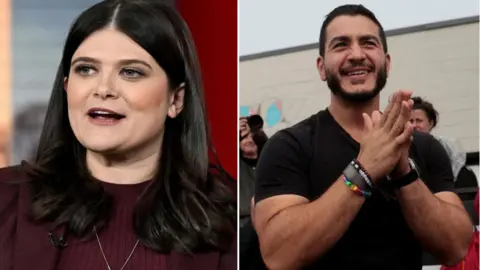
- Haley Stevens and Abdul El-Sayed, Democratic rivals, are engaged in a tight battle in Michigan's Senate primary, with left-wing insurgent Abdul El-Sayed slightly ahead of establishment-backed congresswoman Haley Stevens as more than 90% of the votes are counted.
- The primary contest has highlighted divisions over the party's future and could shape the Democratic Party beyond Michigan; it remains uncertain whether left-wing Democrats can win back working-class voters who supported Trump in 2024.
- The open Senate seat is crucial for Democrats to retake Congress; it is currently held by a retiring Democrat, the last Republican to win it was in 1994, and the primary winner will face Trump ally Mike Rogers on November 3.
- Both candidates addressed their supporters on Tuesday night: Stevens remarked it was a close race and she was 'fired up,' while El-Sayed called for unity to prevent Mike Rogers from entering the US Senate.
- Despite significant spending against him, Abdul El-Sayed, the Bernie Sanders-endorsed champion of Medicare for All, narrowly defeated Rep. Haley Stevens by about a one-point margin, according to the Associated Press; by Wednesday morning, his lead was even smaller.
- Democrats must retain the Michigan seat that Sen. Gary Peters is retiring from, and El-Sayed now faces former Republican Rep. Mike Rogers in a swing state that supported Donald Trump twice; Republicans have not won a US Senate election in Michigan in over three decades.
- With just three months to consolidate Democratic support, El-Sayed told supporters, "Tomorrow, we begin to mend fences," and later mentioned he had a "great conversation" with Stevens, calling her "one of the most committed public servants."
- Stevens was endorsed by Peters and Gov. Gretchen Whitmer and was favored by much of the Democratic establishment, including Senate Minority Leader Chuck Schumer; Tuesday’s results were "yet another reminder" that much of the Democratic base wants to go in a different direction.
- Outside groups spent approximately $60 million, with about half from the AIPAC-backed United Democracy Project; the Michigan race was UDP’s top priority, and the dark-money Center for Democratic Priorities reportedly spent $6.5 million supporting Stevens.
- El-Sayed’s victory was not the only success for the left wing: Will Lawrence won Michigan’s 7th District primary, and Rep. Shri Thanedar lost to Sanders-endorsed Donavan McKinney.
- His victory, along with Daniel Biss’s earlier win in Illinois, indicates that "pro-Israel spending can be successfully resisted"; El-Sayed described taking on AIPAC as "existential" for the party’s future.
Abdul El-Sayed narrowly defeated Haley Stevens in Michigan's Democratic Senate primary, a race that reflects the party's internal struggles. El-Sayed, endorsed by Bernie Sanders and Alexandria Ocasio-Cortez, campaigned on progressive issues like Medicare for All and criticized Stevens' ties to pro-Israel groups.121213141516172122262728
The primary's outcome is crucial for Democrats aiming to retain the seat vacated by Sen. Gary Peters, as they face Mike Rogers, a former Republican representative, in the general election. El-Sayed's victory, albeit by a slim margin, underscores a shift towards progressive values within the party, as he aims to consolidate support ahead of the November elections.678
Stevens, backed by the Democratic establishment, including Michigan Governor Gretchen Whitmer, focused on her experience and commitment to manufacturing jobs. However, the primary results indicate a growing desire among voters for a different direction, challenging traditional party leadership.

El-Sayed's campaign was marked by significant financial backing from progressive groups, while Stevens received substantial support from pro-Israel organizations, highlighting the ideological divide within the party. As El-Sayed prepares for the general election, he emphasized the need for unity among Democrats, stating, "Whatever happens tonight, we have a responsibility to ensure that we unite."
The Michigan race serves as a bellwether for the Democratic Party's future, with El-Sayed's win potentially reshaping expectations for upcoming elections across the country.
“El-Sayed defeated Stevens by about a one-point margin, according to the Associated Press, and his lead was even smaller by Wednesday morning; he now faces Trump ally Mike Rogers in November's midterms. Outside groups spent roughly $60 million, about half from the AIPAC-backed United Democracy Project, which made Michigan its top-priority race.”


 BBC
BBC Mother Jones






