- Hamas and Palestinian factions have agreed on a plan to implement the second phase of the Gaza ceasefire agreement, which includes a gradual process for inventorying and storing their weapons, as reported by Egypt's state TV.
- The National Committee for the Administration of Gaza will oversee the gradual and sequential process of inventorying and storing the weapons, according to an informed Egyptian source.
- Donald Trump announced a 'historic agreement' for the complete disarmament of Hamas and other armed groups in Gaza on his Truth Social platform, stating that the agreement will be carried out in structured phases.
- An Israeli official stated that Israeli troops will not pull back in Gaza without 'genuine' Hamas disarmament, emphasizing the need for the militant group to be disarmed before any withdrawal.
- The agreement includes the committee's entry into Gaza, the deployment of international forces, and early recovery efforts in the enclave, as reported by Egyptian media.
- Hamas has agreed to a plan with international mediators to lay down its heavy weapons on the condition that Israeli forces fully withdraw from Gaza.
- Despite the deal, several Palestinians were wounded in an Israeli airstrike in Gaza, highlighting ongoing tensions in the region.
Donald Trump announced a historic agreement for the complete disarmament of Hamas and other armed groups in Gaza, stating it would be implemented in structured phases.356
“As disarmament is completed, Israeli forces will withdraw,” Trump wrote on Truth Social, emphasizing the role of the International Stabilization Force in maintaining security.
However, an Israeli official cautioned that there will be no withdrawal from the Yellow Line without “genuine disarmament of Hamas.”4

The agreement, which includes a gradual process for inventorying and storing weapons, is overseen by the National Committee for the Administration of Gaza, according to Egyptian state TV.2
“Hamas has agreed to a plan with international mediators to lay down its heavy weapons on condition that Israeli forces fully withdraw from the Gaza territory,” the report stated.
Despite the announcement, violence continues, with reports of Palestinians wounded in an Israeli airstrike.7
“The latest deal is, on the face of it, a significant development - but it raises more questions than it answers,” noted analysts, highlighting the uncertainty over which side will act first.
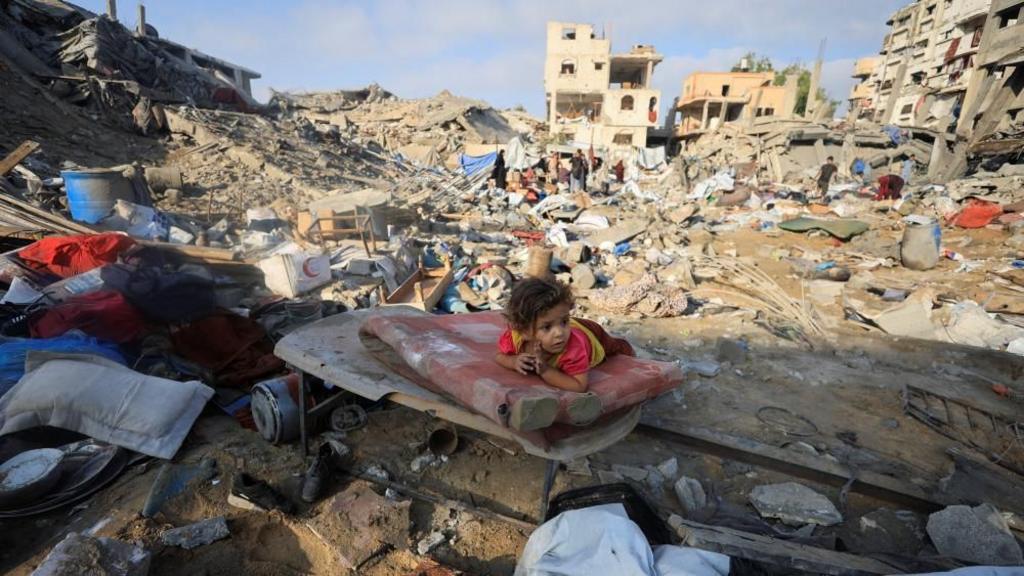
The situation remains complex, with both Hamas and Israel expecting the other to take the initial step in the disarmament process.
“Israel is deeply sceptical about Hamas' willingness to give up its weapons or its control in Gaza,” an expert remarked, pointing to Hamas's historical reluctance to disarm.
The deal is part of a broader US-brokered ceasefire plan aimed at stabilizing the region.
“The plan would have the National Committee for the Administration of Gaza oversee a gradual weapons inventory-and-storage process, tied to committee's entry into Gaza and deployment of the International Stabilization Force. Mediators are to meet in Cairo soon to reaffirm commitments; Israel had not commented by press time.”


 BBC
BBC



