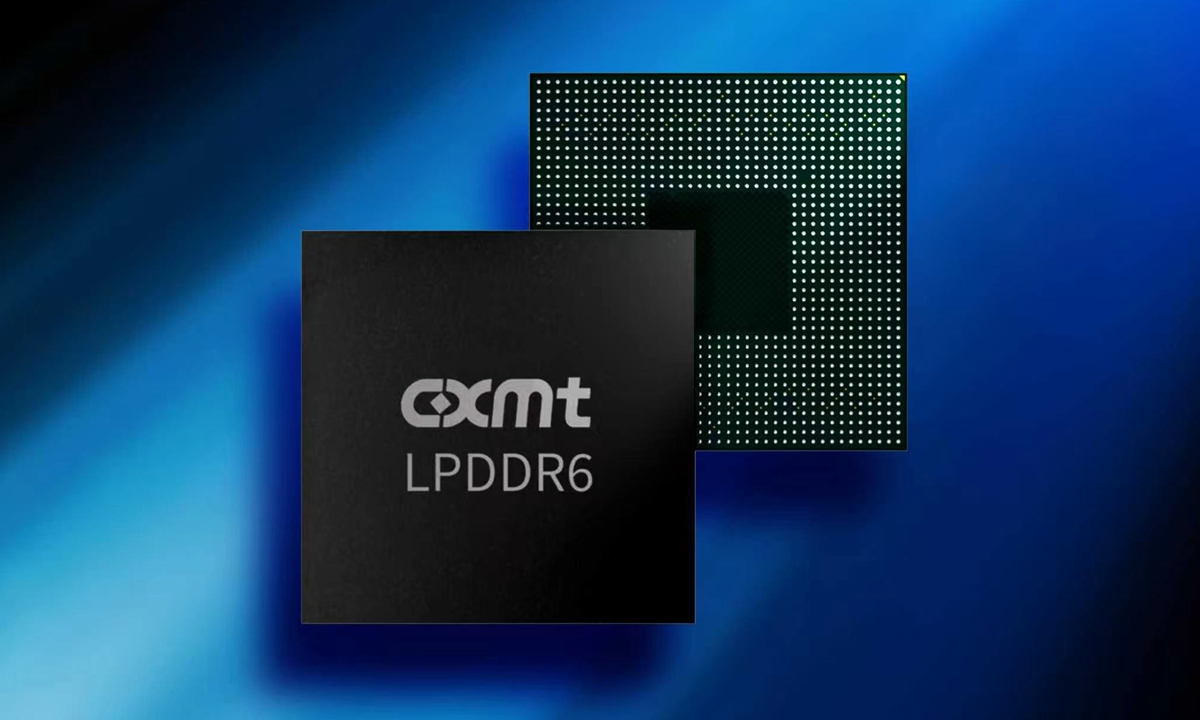
- CXMT took the global lead in next-generation mobile memory with its advanced LPDDR6 memory chip over the weekend.
- CXMT posted first-half revenue of 150.31 billion yuan ($22.37 billion), up 873.64% year-on-year, and net profit of 77.60 billion yuan, reversing a loss of 2.332 billion yuan a year earlier.
- Investors are closely watching how shares of Samsung Electronics and SK Hynix will trade when markets reopen on Monday.
- CXMT attributed booming demand to servers, smartphones and personal computers, as well as emerging segments such as smart vehicles and wearables.
- The report cited Morgan Stanley's projection that CXMT will reach a monthly wafer capacity of 300,000 by year-end, about 13 percent of global DRAM wafer capacity.
- The Chosun Daily drew a series of comparisons between CXMT and the two South Korean suppliers, indicating that competition in the mobile DRAM market could intensify once CXMT begins supplying LPDDR6 to Chinese handset makers.
CXMT's LPDDR6 chip, the world's first commercial LPDDR6 product, has entered mass production, marking a significant milestone for the Chinese memory maker. The chip boasts a peak transfer rate of 12,800 Mbps and a maximum capacity of 16GB.1
The launch follows CXMT's impressive first-half revenue of 150.31 billion yuan ($22.37 billion), a staggering 873.64 percent increase year-on-year, and a net profit of 77.60 billion yuan, reversing a previous loss. This growth is attributed to rising demand across various sectors, including servers, smartphones, and emerging technologies like smart vehicles.2
As CXMT expands its market share, the Chosun Daily notes that competition in the mobile DRAM sector, traditionally dominated by Samsung and SK Hynix, may intensify. CXMT's share in LPDDR4X has grown as Samsung has scaled back production, and the company is projected to reach a monthly wafer capacity of 300,000 by year-end, capturing 13 percent of global DRAM wafer capacity.35
Morgan Stanley forecasts that CXMT's capacity could rise to 500,000 by 2028, with a target price of 88 yuan, significantly higher than its initial offer price. Meanwhile, UBS predicts that the global shipment share of Chinese DRAM makers will increase from 7 percent in 2025 to 9.4 percent in 2027, driven by demand from AI data centers.
CXMT's rapid growth under U.S. restrictions highlights the resilience of Chinese firms, bolstered by a large domestic market and strong infrastructure capabilities.
“CXMT's first-half revenue surged 873.64% to 150.31 billion yuan ($22.37 billion), reversing a year-earlier loss, and Morgan Stanley projects its monthly wafer capacity to hit 300,000 by year-end. The company expects the global supply shortage to persist into the second half, with UBS seeing Chinese DRAM makers' shipment share rising to 9.4% by 2027.”