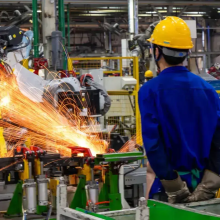
- China's manufacturing activity in August shrank for a second straight month, though by less than market estimates, keeping the pressure on Beijing to support the economy as growth loses momentum.
- The official purchasing managers' index came in at 49.8, compared with 49.2 in July, better than Reuters-polled economists’ forecast of 49.6.
- The non-manufacturing PMI remained unchanged at 49.0, the weakest since December 2022.
- Sub-indexes for production and new orders expanded above 50, indicating growth.
- New export orders rebounded to 50.1 in August from 49.6 in the previous month, signaling a recovery in overseas demand.
- High-tech manufacturing outperformed the broader factory sector, while consumer goods lagged.
- China's economy has come under mounting strain, with growth slowing to 4.3% in the second quarter, the weakest pace since late 2022.
- The economic malaise deepened further in the second half of this year, as consumer spending stalled and urban investment contracted.
- The non-manufacturing gauge tracks construction and services activity, which remained weak, indicating sluggish domestic demand.
China's manufacturing activity contracted for the second month in August, with the official PMI rising to 49.8, surpassing expectations. Despite this improvement, the economy faces significant challenges, including a 4.3% growth rate in Q2, the weakest since late 2022, driven by soft domestic demand and a prolonged property slump.127
The non-manufacturing PMI remained stagnant at 49.0, indicating persistent weakness in the services sector. Retail sales and industrial output have also shown signs of slowing, with urban investment contracting and unemployment rising.3

Economists are cautiously optimistic, anticipating better growth as adverse weather conditions ease and local governments ramp up fiscal spending. Tianchen Xu
The manufacturing sector saw some positive signs, with sub-indexes for production and new orders rising to 50.4 and 50.6, respectively. New export orders rebounded to 50.1, suggesting a recovery in overseas demand despite global economic challenges.45
However, Zhiwei Zhang cautioned that it is premature to declare a rebound, emphasizing the need for continued government investment to bolster business confidence and stimulate economic recovery.
Overall, while the PMI data indicates some improvement, the underlying economic conditions remain fragile, necessitating further policy measures to support growth.
“The non-manufacturing PMI held at 49.0, the weakest since December 2022, with construction sub-index falling to 46.9. High-tech manufacturing sub-indexes topped 53, while consumer goods production lagged at 49, underscoring uneven demand.”
 CNBC
CNBC






