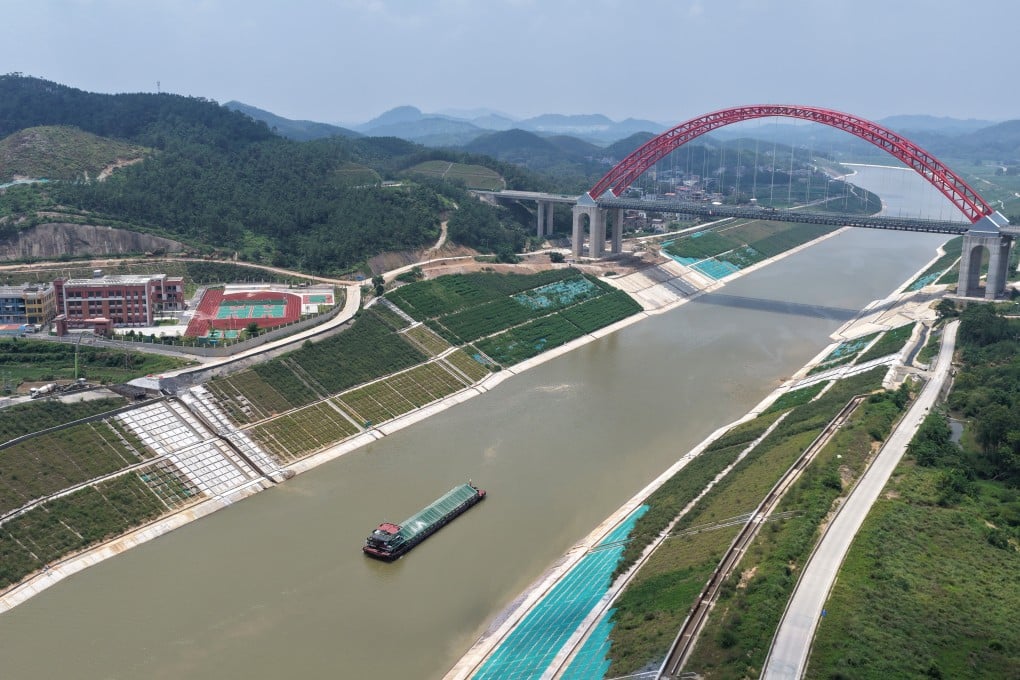
- China officially opened the Pinglu Canal for navigation on Wednesday, creating a new maritime gateway for the country’s southwestern hinterland and providing a shorter route to Southeast Asia as Beijing seeks to enhance trade.
- The 134.2km (83.4 mile) waterway links Nanning, the capital of Guangxi, to the Gulf of Tonkin, allowing cargo from inland provinces to reach the sea without taking a roughly 560km detour via Guangzhou, cutting both transit times and logistics costs.
- On its opening day, about 30 cargo vessels carrying goods such as building materials, coal, minerals, steel, and fertiliser passed through the canal, with Nanning Port and Qinzhou Port handling operations.
- Two new freight routes have begun operation: an international route linking Nanning with Can Tho in Vietnam, and a domestic route connecting Nanning with Yangpu in southern Hainan.
- Direct commercial sailings to Can Tho are scheduled to begin after the canal opens.
- Tolls on the canal are free until December 31, 2026, after which a fee of one yuan per tonne will be charged until September 2031.
- The Pinglu Canal is part of the New International Land-Sea Trade Corridor and the Belt and Road Initiative, aimed at linking areas in western and southwestern China with Southeast Asian countries and global markets.
- According to local authorities in Guangxi, the canal will shorten the shipping distance between inland areas of southwest China and Southeast Asian countries by about 560km (350 miles) and reduce logistics costs by 18 to 30 percent.
- Estimates indicate that transport costs alone will come down by more than 5 billion yuan annually, or about $700m.
China has opened the Pinglu Canal, its first modern river-to-sea waterway, on Wednesday, marking a significant advancement in maritime logistics.1
The 134.2km (83.4 mile) canal connects Nanning, Guangxi's capital, to the Gulf of Tonkin, allowing cargo to bypass a 560km detour via Guangzhou.2
This new route is expected to cut transit times and logistics costs by 18 to 30 percent.9
On its opening day, about 30 cargo vessels transported goods like building materials and coal through the canal, with operations managed by Nanning Port and Qinzhou Port.3
The canal is part of the New International Land-Sea Trade Corridor, which aims to link southwestern China with Southeast Asia and global markets, enhancing trade opportunities.8

According to estimates, transport costs will decrease by more than 5 billion yuan (approximately $700 million) annually.
The Pinglu Canal is also expected to boost container-handling capacity at Beibu Gulf Port, which rose from 2.28 million TEUs in 2017 to 10.06 million TEUs in 2025.
Guangxi plans to develop the “Pinglu Canal Economic Belt” to attract industries along the corridor, targeting sectors like non-ferrous metals and artificial intelligence.
Until December 31, 2026, vessels can pass through the canal's gates free of charge, with a nominal fee starting in 2027.
“The 134.2km canal links Nanning to the Beibu Gulf, cutting shipping distance by about 560km and reducing logistics costs by 18-30%. It is part of the Belt and Road Initiative, with transport costs expected to drop by over 5 billion yuan annually.”
 South China Morning Post