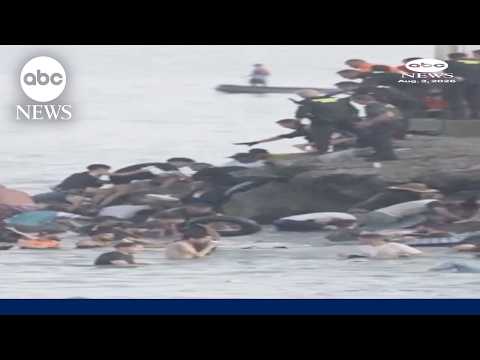
- Ceuta's leader has accused Morocco of an 'atrocity' regarding the recent mass border crossing of migrants into the Spanish enclave.
- The preliminary assessment of Spanish intelligence services concluded that Morocco had failed to stem the tide and in some cases facilitated passage for migrants, which was linked to a social media hoax following a Spanish supreme court ruling.
- Migrants described their ordeal in Ceuta, stating that Moroccan police pushed them toward the water, urging them to 'swim', while one mother searched desperately for her missing children.
- Spain’s foreign minister José Manuel Albares stated that Spain would demand EU solidarity after some countries had 'fallen short' in their response to the crisis.
- Ursula von der Leyen, the European Commission president, commended Spain for its swift handling of the crisis and emphasized the need to 'further strengthen our borders'.
- EU member states suspected the Ceuta crisis was coordinated rather than accidental, with claims of an 'intensive Russian propaganda campaign' using images from Ceuta to create destabilization.
Ceuta's leader, Juan Jesús Vivas, has accused Morocco of orchestrating an 'atrocity' as thousands of migrants flooded into the Spanish enclave, leading to 88 reported deaths.1
Vivas stated, “People see this not as a migration crisis; it was fundamentally an attack, a violation of Spain’s territorial integrity.”
Spain's interior ministry reported that 48,300 of the approximately 50,000 migrants were sent back to Morocco amid claims of Moroccan facilitation of the border surge.
The Spanish intelligence assessment suggested that while the influx was not directly planned by Moroccan authorities, they failed to control the situation, allowing tens of thousands to cross the border.
A hoax circulating on social media, following a Spanish supreme court ruling on migrant deportations, likely fueled the crisis, as Moroccan border surveillance diminished significantly.
One mother, desperately searching for her children, lamented, “I need help,” holding a photo of her son.
Spain's foreign minister called for EU solidarity, criticizing member states for falling short in their responses. “There was a synchronised reactionary international effort that very quickly amplified what was happening,” he stated.4
European Commission President Ursula von der Leyen emphasized the need for stronger border controls, stating, “From this incident, it is clear that we must do more to further strengthen our borders at critical points.”5
The situation has drawn international scrutiny, with reports of a coordinated response and misinformation campaigns complicating the crisis.6
“Spain's interior ministry says 48,300 of some 50,000 migrants who reached Ceuta have been sent back, as Spanish intelligence suspects Morocco failed to stem the rush and in some cases eased passage. The crisis also drew EU diplomacy: von der Leyen called for strengthening borders, while Spain's foreign minister accused some governments of amplifying lies.”


 The Guardian



