- The wreck of a steam tugboat dating from the early 1900s is the latest relic to emerge from shrinking waters in Serbia as Europe's rivers run dry, with the continent engulfed in prolonged, extreme heat and drought.
- The rusting hull — once a famed vessel known as the Slovenian — surfaced earlier this month from the Sava River near the Serbian town of Sremska Mitrovica, 70 kilometers (45 miles) northwest of the capital of Belgrade.
- Historian Andrija Popovic, head of the town museum, noted that while parts of the wreck have appeared above the surface before, it has never been so exposed.
- Popovic described the boat, dubbed 'Sava's Titanic' by Serbian media, as something you don't see every day.
- The current drought has also revealed warships, mammoth bones, and ancient structures across Europe, disrupting trade, power, and water supplies.
- According to Popovic, the Slovenian was made in 1913 in a shipyard in Budapest, Hungary, then part of the Austro-Hungarian Empire.
- The boat measured roughly 54 meters (177 feet) in length and was initially named Vag, which is Hungarian for Slovakia's longest river, Vah.
- After World War I, the boat's ownership switched to the newly formed Kingdom of Serbs, Croats and Slovenians as part of war reparations.
- During World War II, the Slovenian was used by Yugoslav anti-fascist forces to transfer the wounded and equipment while pushing German troops further west.
- The boat sank in late April 1945 after hitting a German mine and has stayed in the same place since that day.
A century-old steam tugboat, known as the Slovenian and dubbed 'Sava's Titanic,' has emerged from the Sava River in Serbia due to severe drought conditions affecting Europe.6
The rusting hull surfaced earlier this month near Sremska Mitrovica, approximately 70 kilometers (45 miles) northwest of Belgrade. Historian Andrija Popovic, head of the town museum, remarked, "It's been several years since it was last seen, so there is quite an interest." He added, "It's truly something you don't see every day."234
The Slovenian was built in 1913 in Budapest, Hungary, and initially named Vag, which means Slovakia's longest river, Vah. It measured roughly 54 meters (177 feet) in length and was used to transport heavy cargo along the Danube. After World War I, it became part of the Kingdom of Serbs, Croats, and Slovenes, later known as Yugoslavia, as part of war reparations.7
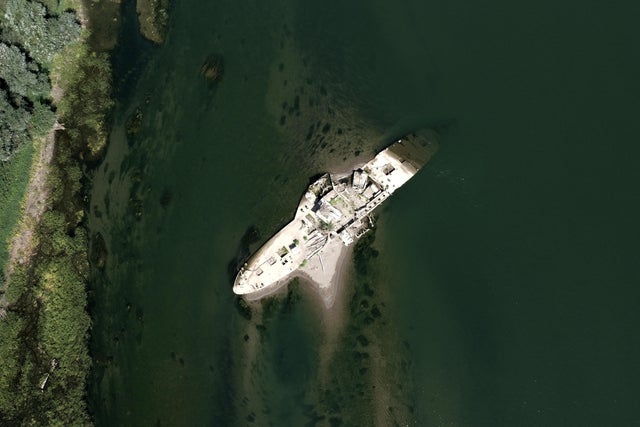
During World War II, the vessel was used by Yugoslav anti-fascist forces to transport wounded soldiers. Tragically, it sank after hitting a German mine in April 1945 and has remained submerged since.
The current drought, attributed to a lack of winter snow and dry spring, has led to record-low water levels across Europe, impacting trade and agriculture. Serbian hydrology expert Dejan Vladikovic warned that such droughts may become more frequent in the future.
“The drought has also exposed Nazi warships in the Danube, an ancient Roman bridge in Italy, and a woolly mammoth jawbone in Bulgaria. Half of the EU and UK were in drought by late July 2026, with 9% at the most severe alert level, according to the European Drought Observatory.”

 AP News
 CBS News