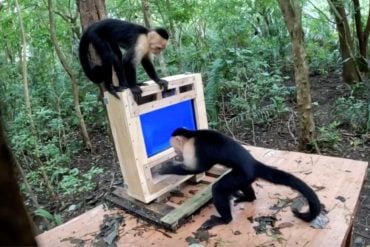
- Researchers developed CapuchinAI, an open-source, battery-powered platform that automates cognitive studies of wild primates using facial recognition and touchscreen interaction.
- Field-tested in Costa Rica's Taboga Forest Reserve, the system uses YOLO computer vision to identify wild white-faced capuchins with 97 percent accuracy, deliver personalized touchscreen tasks via a Raspberry Pi microcomputer, and dispense food rewards automatically.
- Trained on GoPro video datasets using the open-source YOLO (You Only Look Once) architecture, the vision pipeline identified specific individual capuchins in wild environments with 97 percent accuracy.
- The automated software tracks individual participation limits per session, preventing dominant group members from monopolizing the testing box and ensuring balanced data collection across the troop.
- Wild white-faced capuchins (*Cebus capucinus*) in Costa Rica quickly habituated to the physical platform, learning touchscreen-reward associations spontaneously without human intervention or hand-testing.
- The American Journal of Primatology published a proof-of-concept for the novel method — dubbed CapuchinAI — developed by researchers at Emory University and Georgia Institute of Technology.
CapuchinAI is a groundbreaking system designed to automate cognitive testing of wild capuchin monkeys, achieving an impressive 97% accuracy in identifying individual capuchins. Developed by researchers at Emory University and Georgia Institute of Technology, this open-source platform was field-tested in Costa Rica's Taboga Forest Reserve.1
The system employs facial recognition technology and interactive touchscreen tasks, allowing researchers to deliver personalized learning experiences to the monkeys. It operates on a Raspberry Pi microcomputer and includes an automated food dispenser that rewards the monkeys for correct task performance. This innovative approach not only enhances data collection but also prevents dominant individuals from monopolizing the testing process, ensuring balanced participation across the troop.

According to the researchers, the AI model is adaptable to other wild primate species, potentially broadening its application in cognitive studies. “We can explore outstanding questions about how the environment, individual experiences and behaviors connect to cognitive abilities,” said Benítez, one of the researchers involved in the project. The findings were published in the American Journal of Primatology, highlighting the potential of CapuchinAI to transform the study of primate cognition in natural settings.6
This novel method not only advances our understanding of capuchin cognition but also opens avenues for studying other primate species, paving the way for future research in wildlife cognition and behavior.
“CapuchinAI integrates facial recognition and touchscreen tasks to facilitate cognitive studies, allowing wild white-faced capuchins to learn tasks without human intervention. The automated system also tracks individual participation, ensuring balanced data collection across the troop, which could enhance understanding of primate cognition.”
 Neuroscience News
 News-Medical



