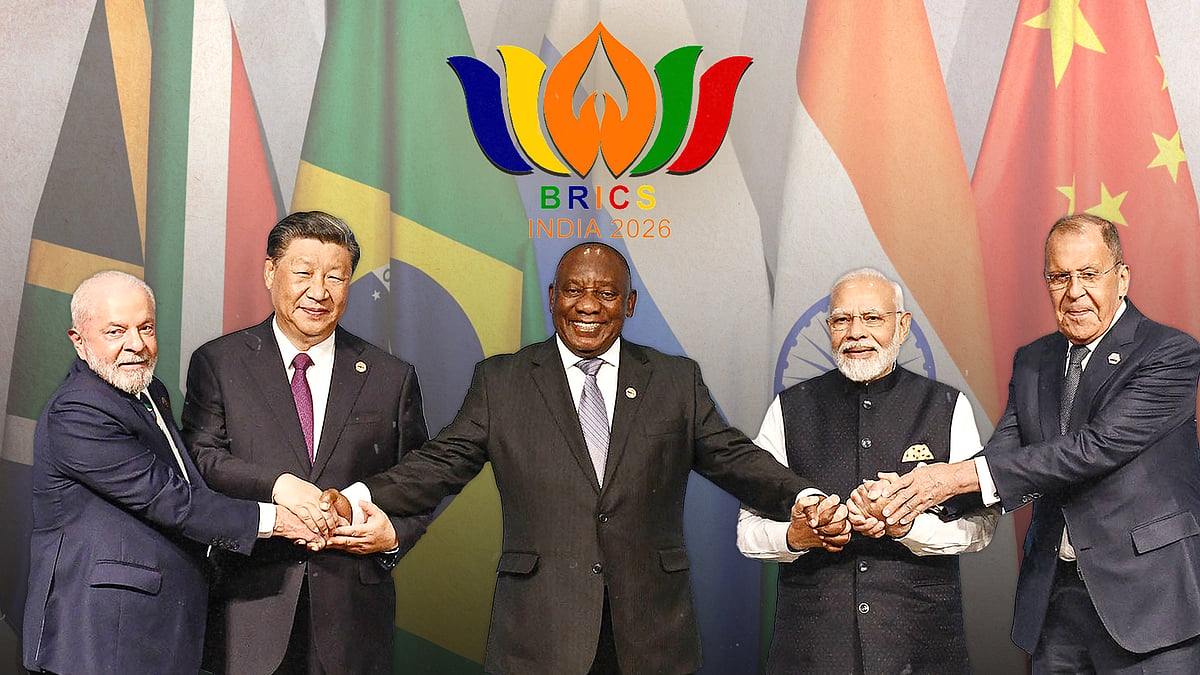
BRICS struggles for consensus on West Asia amid tensions involving Iran and Gulf states; India seeks to maintain unity through calibrated ambiguity.

BRICS failed to reach an agreement on the ongoing conflict in West Asia due to tensions involving member countries like Iran and Gulf states. India's use of calibrated ambiguity aims to keep the group's cohesion despite these challenges.

Sources:
Newslaundry+1
Trending 1h ago
Tab background
Sources: Newslaundry
BRICS struggling for consensus on West Asia highlighted the difficulties faced by the bloc in the face of emerging tensions involving Iran, Saudi Arabia, and the UAE. The latest meeting of deputy foreign ministers revealed a landscape where at least three member countries are directly affected by the ongoing conflict.

The Chair’s statement indicated that while members shared deep concerns regarding the Middle East situation, reaching a joint position remained elusive. India, as the current chair, has attempted to navigate these complex dynamics through a method of calibrated ambiguity. This approach reflects the country’s intricate ties: its defence partnerships with Israel, economic relations with Gulf states, and strategic partnerships with both Iran and the United States.

The absence of a joint communique at this latest meeting signaled a shift in BRICS's identity, indicating that it is evolving less as a cohesive bloc and more as a platform where multiple perspectives coexist. This nuance is vital as India prepares to host the BRICS summit in 2026, a time when focusing on achievable cooperation will be essential amidst diverging interests.

India is expected to facilitate discussions among BRICS nations without forcing consensus, a recognition that diverse interests might lead to counterproductive outcomes if improperly managed. Hence, the approach towards West Asia reflects a balancing act that acknowledges the flaws of seeking an overly simplified agreement amidst profound geopolitical tensions.
Sources: Newslaundry
BRICS countries are struggling to reach consensus on West Asia amid tensions involving Iran, Saudi Arabia, and the UAE, with India, the current chair, attempting to maintain unity through a strategy of calibrated ambiguity while recognizing the complexities of the evolving geopolitical landscape.
Section 1 background
The Headline

BRICS struggles for West Asia consensus

Key Facts
  • Consensus over West Asia continued to elude BRICS, with at least three member countries, Iran, Saudi Arabia, and the UAE, directly involved in the ongoing conflict.1
  • India, the current chair of BRICS, is using calibrated ambiguity to facilitate discussions among members to maintain unity amid differing views.Newslaundry
  • Members expressed deep concern over the recent conflict in the Middle East, highlighting the struggle to forge a consensus.1
  • A meeting of foreign ministers from the BRICS nations concluded without a joint position on the intensifying West Asian conflict.Newslaundry
  • The inability to reach consensus on the West Asian crisis is characteristic of the evolving nature of BRICS as a more diverse and complex group.Newslaundry

Related Videos

Iran FM Abbas Araghchi Meets Pakistan PM Shehbaz Sharif in Islamabad | N18G
IranPakistanAbbas AraghchiShehbaz SharifIslamabad
Iran Says Most Missile Capabilities Remain Unused in War With US | Iran War | Trump | Israel
Iranmissile capabilitiesUSIsraelIran War
Iran FM Abbas Araqchi Arrives in Pakistan Amid Uncertainty Over US Talks | N18G
IranPakistanAbbas AraghchiAsim MunirIslamabad
Iranian foreign minister arrives in Islamabad ahead of possible US talks
Iranforeign ministerAbbas AraghchiIslamabadUS talks
Section 2 background
Background Context

Context of BRICS's evolving role

Key Facts
  • The inclusion of new members from West Asia and Africa has expanded BRICS's geographic and economic footprint.Newslaundry
  • India's strategic interests involve defence cooperation with Israel, connectivity with Iran, and economic ties with Gulf states, complicating its position within BRICS.Newslaundry
  • India’s facilitation role is intended to promote convergence among BRICS countries without imposing strict agreements.Newslaundry
  • The use of a Chair’s Summary reflects a recognition that forcing agreement is often counterproductive, indicating a shift in BRICS's operating dynamics.Newslaundry
Article not found
CuriousCats.ai

Article

Source Citations