- U.S. Treasury Secretary Scott Bessent announced that the United States will impose "the toughest sanctions in history" on Iran, urging Beijing to cooperate.
- Bessent described the strategy as a "one-two punch" combining a blockade and sanctions, and stated that the goal is to "collapse this regime".
- President Donald Trump warned of economic consequences for any country providing a "lifeline to Iran".
- Bessent urged US partners to back plans to "squash" Iran's economy, describing a "one-two punch" of blockade and sanctions.
- Bessent confirmed further details about the plan will be made public at a press conference on 24 August.
- Bessent stated the US will "squash the economy of this murderous regime" and that the new economic penalties will be part of "the greatest coordinated economic isolation in the history of the world".
- Bessent warned that allies who continue doing business with Iran, including transferring money or buying oil, will face the "full might and force" of the US Treasury and government.
- Bessent argued the pressure campaign on the Iranian economy will minimise the need for a "large-scale kinetic restart" of the conflict.
- Bessent expressed confidence that all parties want the Strait of Hormuz reopened and energy prices to come down.
- Bessent urged China to cooperate, noting that China gets 50% of its energy from inside the Gulf, and that China buys more than 80% of Iran's shipped oil.
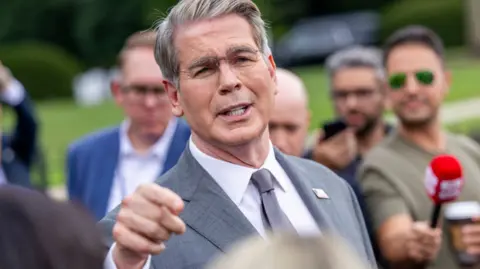
U.S. Treasury Secretary Scott Bessent has called on global allies to back a plan aimed at crippling Iran's economy through what he describes as the toughest sanctions in history. Speaking to CNBC, Bessent stated, "It is time for our allies and the rest of the world to make a decision" regarding their support for U.S. efforts to isolate Iran economically.1
Bessent emphasized that the sanctions will be part of "the greatest coordinated economic isolation in the history of the world", warning that countries engaging in business with Iran could face severe repercussions. "If you insist on doing business with them... then the US Treasury and the US government will put [their] full might and force towards enforcing against you," he cautioned.78
The Treasury Secretary's remarks come as the U.S. prepares to implement a pressure campaign designed to minimize the likelihood of military conflict. He noted, "If we are doing the maximum economic pressure, then that means that likely there will not be a large-scale kinetic restart" of hostilities.
Bessent also urged China to cooperate, highlighting that the nation relies on the Gulf for 50% of its energy needs. "Keep in mind that the Chinese get 50% (of their) energy from inside the Gulf. So it would do them a big service to get with the program," he stated. The U.S. aims to ensure that countries reconsider their economic ties with Iran, especially as China buys more than 80% of Iran's shipped oil, according to analytics firm Kpler.
Bessent is set to provide further details on the sanctions during a press conference scheduled for August 24.
“Bessent warned that allies continuing business with Iran face the 'full might and force' of the US Treasury, and argued the pressure campaign will minimize the need for a 'large-scale kinetic restart'. He also noted China buys over 80% of Iran's shipped oil, urging Beijing to 'get with the program'.”


 BBC
BBC