- Ancient DNA sequencing of 712 new genomes alongside 4,009 others has revealed significant insights into the spread of Germanic and Celtic languages across Europe.
- Researchers identified a migration from the Baltic region into Denmark and southern Sweden around 4,000 years ago, which may have introduced Germanic languages to Scandinavia.
- A westward migration from eastern central Europe around 3,000 years ago is believed to have spread Celtic languages across regions including France, Britain, and Ireland.
- Around 1,650 years ago, people migrated from Scandinavia into Germany, Poland, and the Netherlands, where Celtic languages were likely spoken at the time.
- The findings were published in two complementary papers in Nature, marking a significant advancement in understanding the linguistic history of Europe.
- Genetic evidence combined with linguistic and archaeological data allows researchers to trace how languages spread and evolved over thousands of years.
- The research challenges the long-held assumption that the roots of Germanic languages arrived with earlier migrations about 5,000 years ago.
- Scholars have debated the origins and spread of Germanic languages for over a century, and this new evidence provides a basis for testing these theories.

Recent research led by the University of Copenhagen reveals that Germanic languages may have arrived in Scandinavia 800 years later than previously believed, due to a significant migration from the Baltic region.2
The study, published in *Nature*, analyzed DNA from over 4,500 ancient individuals, including 712 newly sequenced genomes.
"DNA sequences do not tell us directly which language people spoke. But by combining ancient DNA with linguistic and archaeological evidence, we can begin to trace how languages spread and changed over thousands of years," says Eske Willerslev, a geneticist at the University of Copenhagen.

The researchers identified a previously unknown migration into Scandinavia around 4,000 years ago, suggesting that these newcomers may have introduced the earliest forms of Germanic languages.
"For over a century, scholars have debated when and from where the Germanic languages arrived in northern Europe. What is exciting is that we can now test some of these ideas directly," says Hugh McColl, lead author of the study.8
This challenges the long-held assumption that Germanic languages arrived with earlier migrations about 5,000 years ago. Instead, the findings suggest that the linguistic foundations of English, German, Dutch, and Scandinavian languages may have spread 1,000 years later than previously thought.7
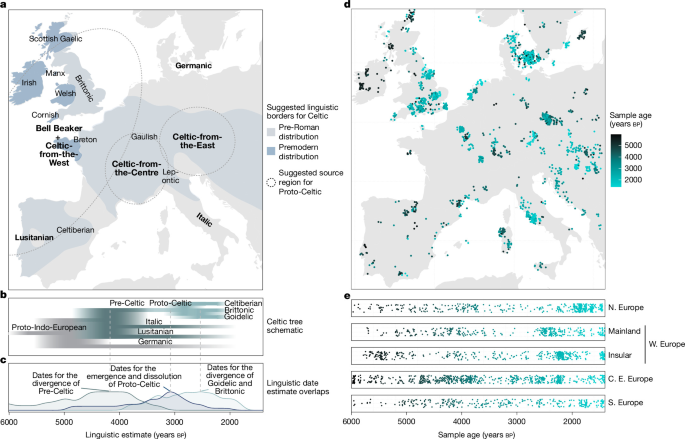
The research also sheds light on the origins of Celtic languages, which were believed to have originated on Europe's Atlantic coast. The new evidence indicates that Celtic languages spread during a westward migration from eastern central Europe around 3,000 years ago.3
"This migration came as a real surprise. Archaeologists and linguists had not predicted it, but it helps explain several cultural and linguistic connections between Scandinavia and Britain that have puzzled researchers for a long time," McColl adds.
The findings underscore the importance of integrating genetics, archaeology, and linguistics to address long-standing questions about language evolution in Europe.
“The study, published in Nature, analyzed over 4,500 ancient individuals, including 712 newly sequenced genomes. It suggests Celtic languages spread via a westward migration from eastern central Europe about 3,000 years ago, challenging the Atlantic coast origin theory that has been debated for over a century.”
Nature