
- A westward expansion of Knovíz–Urnfield-related ancestry from eastern central Europe occurred between 3,200 and 2,800 years ago.
- Researchers concluded that movement 3 is the most parsimonious vector for the spread of Celtic languages, supporting the Celtic-from-the-East model.
- Steppe ancestry arrived in Europe with Bell Beaker groups around 4,400–4,000 years ago.
- A separate movement from southwestern Europe into Britain occurred around 3,800 years ago.

A recent study involving the analysis of DNA from 4,587 ancient individuals has provided new insights into the origins of Germanic and Celtic languages. Researchers from the University of Copenhagen and Leiden University found that between 3,200 and 2,800 years ago, populations associated with the Urnfield culture expanded westward, aligning with the spread of Celtic languages from eastern central Europe.1
The study challenges previous models, particularly the Celtic-from-the-West theory, which suggested that Celtic languages emerged from maritime networks in southwestern Europe. Instead, the findings support the Celtic-from-the-East model, indicating that the final movement of populations from eastern central Europe is the most parsimonious explanation for the spread of Celtic languages.4
Interestingly, the research also highlights an earlier migration from southwestern Europe into Britain around 3,800 years ago, suggesting a more complex interplay of migrations that influenced linguistic development. This earlier migration partially supports theories of western Celtic origins, indicating that the linguistic landscape was shaped by multiple demographic movements.
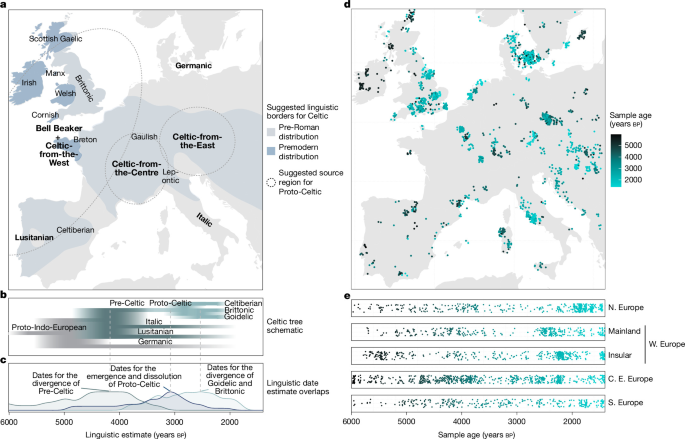
The study emphasizes that linguistic change is not solely driven by demographic factors, as cultural contact among closely related communities also played a significant role in the evolution of languages. The findings underscore the intricate history of language development in prehistoric Europe, revealing a tapestry of migrations and cultural exchanges that shaped the linguistic heritage of the continent.
Overall, this research marks a significant advancement in understanding the origins of Celtic and Germanic languages, providing a clearer picture of how ancient populations interacted and influenced each other linguistically.
“The study analyzed 4,587 ancient genomes, including more than 700 newly sequenced individuals, and identified three population movements that intersect with four linguistic models. The Celtic-from-the-East model, linked to the Urnfield culture, required the fewest assumptions to explain Celtic's historical distribution across Europe.”
Nature



