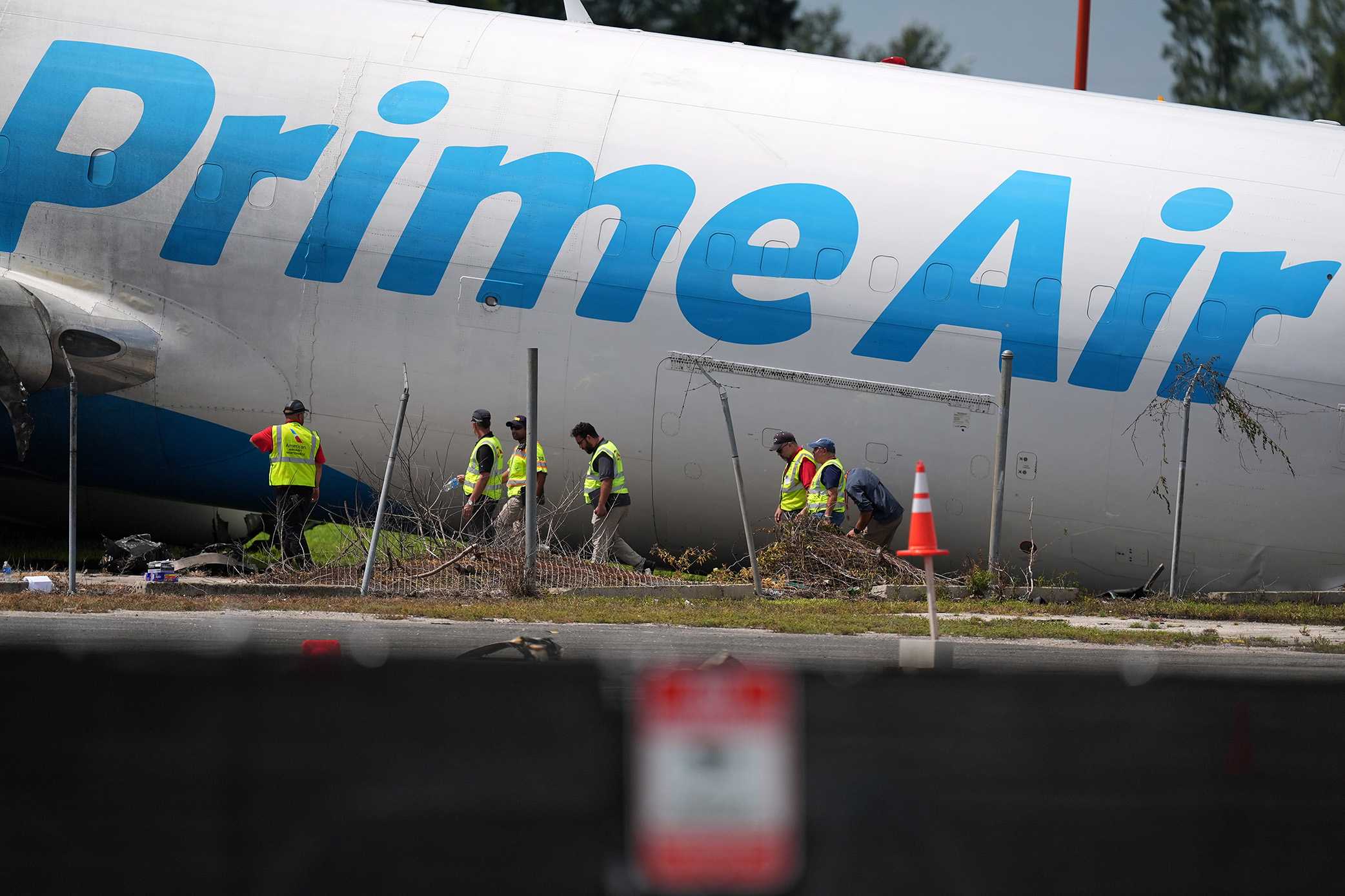
- An Amazon cargo plane overshot the runway at Miami International Airport on Sunday, crashing into a van and resulting in the deaths of five people inside.
- Initial flight data released by the NTSB on Tuesday night indicates that the pilots of the cargo plane briefly considered a go-around before ultimately abandoning it.
- NTSB Chairwoman Jennifer Homendy stated that the thrust reversers were never used during the landing attempt, and investigators plan to interview the pilots on Wednesday.
- The Miami-Dade sheriff identified the deceased as Rolando Aleman Leon, Yoel Rodriguez Naranjo, Julio C. Pineda, Carlos Acosta Fajardo, and Javierkys Reyes Quevedo, while reporting that two others remain in critical condition and one is stable.
- The crash raises safety concerns for airport workers, as noted by Homendy, who remarked on the tragedy of the incident occurring while employees were in a van cleaning an airplane.
- The plane, operated by 21 Air, was a 32-year-old Boeing 767 that had been converted from passenger to cargo use in 2015.
- The NTSB is reviewing flight data and cockpit recordings to understand the events leading up to the crash, which involved the plane overrunning the runway by approximately 1,300 feet.
Initial flight data indicates that the Amazon cargo plane attempted to abort its landing before crashing into a van at Miami International Airport, resulting in five fatalities. The NTSB is set to interview the pilots to uncover the reasons behind the crash.1267
The plane overshot the runway by approximately 1,300 feet (396 meters) and struck a van owned by Professional Ocean Service Corp., killing all five occupants. The deceased have been identified as Rolando Aleman Leon, 55; Yoel Rodriguez Naranjo, 53; Julio C. Pineda, 75; Carlos Acosta Fajardo, 53; and Javierkys Reyes Quevedo, 47.

NTSB Chairwoman Jennifer Homendy stated that investigators are reviewing flight data and cockpit recordings to understand the events leading up to the crash. She noted that the thrust reversers were not utilized during the landing attempt, which was described as unstable by former FAA official Mike O'Donnell, who suggested that a go-around should have been executed sooner.3

Aviation attorney Mary Schiavo speculated that there may have been a disagreement between the pilots regarding the landing approach. The pilot and co-pilot have since been released from the hospital, while two individuals remain in critical condition.4
The investigation continues as the NTSB aims to piece together the sequence of events that led to this tragic incident.
“The NTSB's review of flight data shows the thrust reversers were never used, and the plane traveled about 1,300 feet past the runway end. Former FAA official Mike O'Donnell said the landing was unstable and a go-around should have been executed sooner, suggesting pilot hesitation.”


 Sun Sentinel