- AI large language models excel at text generation but are not suited for physical work, leading to the proposal of large action models for real-world tasks.
- Agentic AI has transitioned from research labs to enterprise production, evolving from chatbots to autonomous agents capable of planning and executing multi-step tasks.
- Enterprises adopting agentic AI are experiencing significant productivity gains as humans transition from routine execution to oversight roles.
- AI agents are now deployed across various sectors including customer support, coding, logistics, healthcare, and banking to autonomously manage tasks such as refunds, code generation, rerouting, documentation, and fraud analysis.
- AI support agents can autonomously draft responses, look up inventory, process returns, and update CRM tickets without human intervention.
- Intelligent Routing allows agents to escalate tickets requiring human empathy or high-level authorization, providing a summary of the issue and prior context.
- Proactive Follow-ups enable agents to anticipate issues, such as delayed flights or orders, and resolve them before customers are aware.
- In coding, AI agents can autonomously handle tasks from high-level GitHub issues to submitting pull requests, often without developer intervention.
- Logistics companies are deploying multi-agent systems to monitor data feeds and autonomously reroute shipments, significantly reducing response times.
- In healthcare, AI agents manage patient data, coordinate scheduling, and generate clinical notes, alleviating administrative burdens.
- In banking, AI agents conduct deep investigations into flagged activities, making faster and more accurate decisions than traditional methods.
AI agents are reshaping industries by moving from research to production, enabling significant productivity gains. In customer support, agents autonomously resolve complex issues, while in banking, they conduct deep investigations into flagged activities. This shift allows humans to focus on oversight and strategic roles.3411
In customer support, today's AI agents integrate with CRM systems to autonomously handle tasks like processing refunds and rescheduling shipments. They can draft responses, look up inventory, and update tickets without human intervention. If a situation requires human empathy, the agent escalates the issue with a summary.
In logistics, multi-agent systems monitor global data feeds, autonomously rerouting shipments during disruptions, compressing response times from days to minutes. They also manage inventory by executing purchase orders based on demand signals.
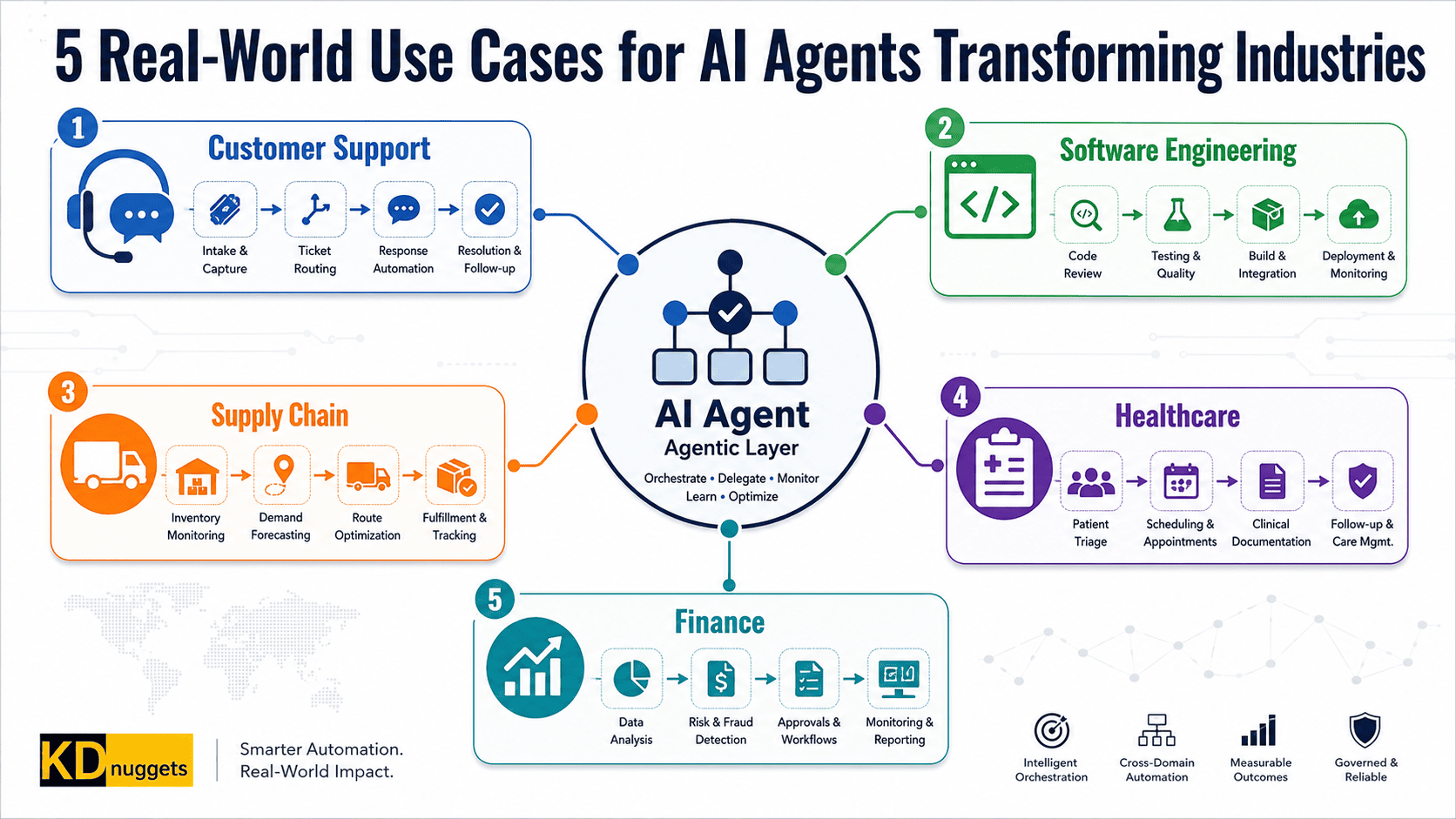
In healthcare, AI agents manage patient data and scheduling, generating clinical notes and handling pre-authorization paperwork swiftly. They follow up with patients post-discharge, monitoring recovery and escalating issues as needed.10
In banking, AI agents conduct deep KYC investigations, autonomously building risk profiles and making real-time fraud analysis decisions, significantly reducing the compliance burden on human analysts.
This transition from generative to agentic AI marks a pivotal moment in technology, allowing for a more efficient division of labor across sectors.2
“Enterprises adopting agentic AI report significant productivity gains as humans shift from routine execution to oversight. Agents now handle tasks like drafting responses, searching codebases, rerouting shipments, and drafting regulatory reports, compressing response times from days to minutes.”
 WSJ
WSJ