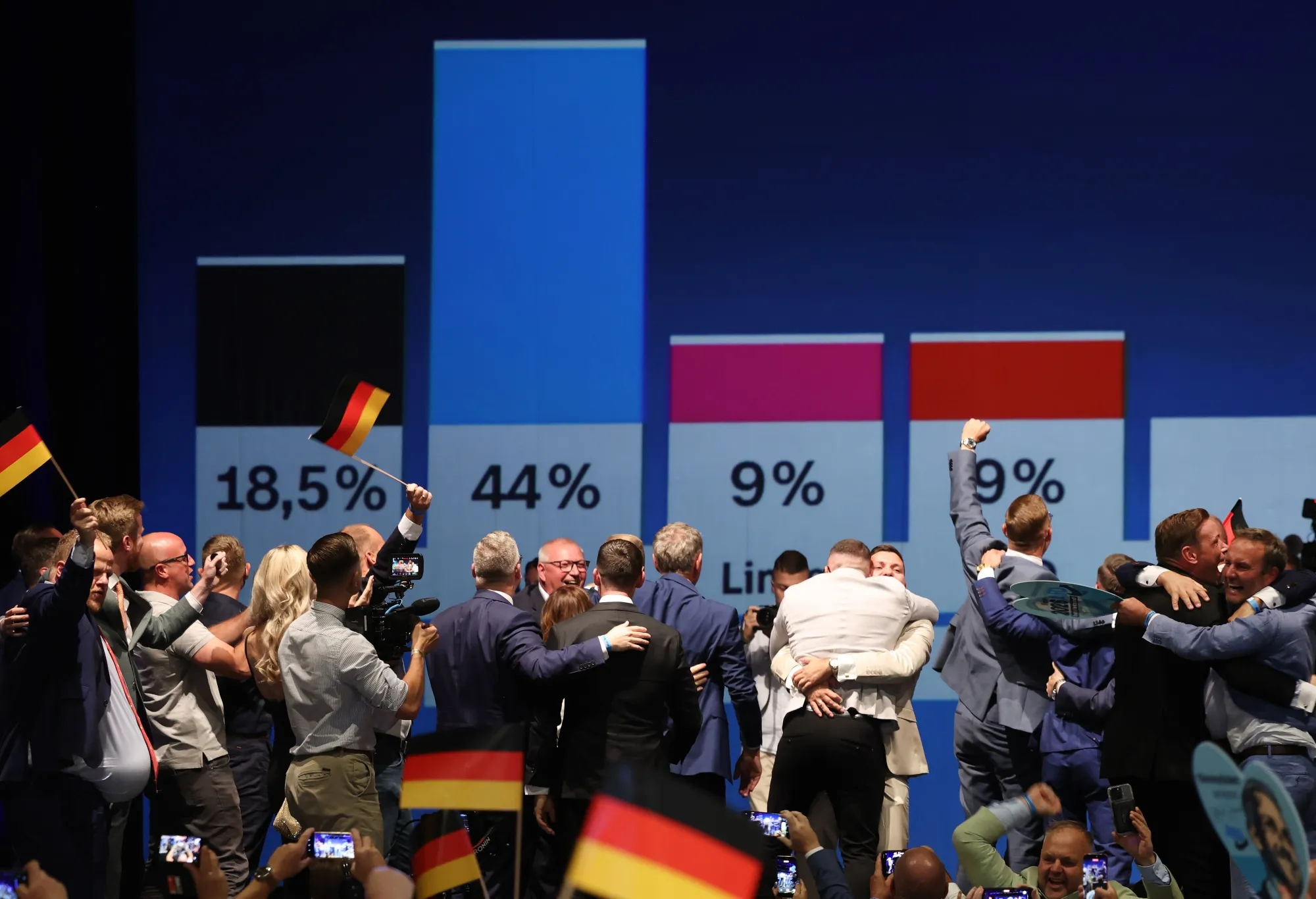
- The AfD has won in Saxony-Anhalt, but due to Germany's proportional representation, it does not have an absolute majority and may need support from the Sahra Wagenknecht Alliance, which received 5.3 per cent.
- German Chancellor Friedrich Merz has ruled out any cooperation with the AfD in Saxony-Anhalt and is seeking to form a shaky alliance to prevent it from gaining power.
- French Finance Minister Roland Lescure has urged the world to 'resist' the 'populist wave' following the AfD's victory.
- Journalist Tilo Jung raised concerns at an AfD press conference about parallels to 1932, when Anhalt elected the first Nazi state president.
- In 2015, then-chancellor Angela Merkel stated 'Wir schaffen das' and Germany accepted 1.2 million migrants, which has been a significant factor in the AfD's rise.
- By 2020, many immigrants remained poorly integrated and unemployed, contributing to ongoing tensions.
- The AfD's support surged from 4 to 18 per cent in polls between 2015 and 2018, largely due to its anti-immigration platform.
- Incidents like the New Year’s Eve 2016 assaults, where women were sexually assaulted by groups mostly of North African or Arab origin, significantly boosted the AfD's message.
- Saxony-Anhalt has the lowest economic performance in Germany, which has contributed to voter discontent.
- Voter sentiment in Saxony-Anhalt may reflect frustration with governments that have not fulfilled their promises, drawing parallels to U.S. President Donald Trump.
The Alternative for Germany (AfD) party's recent victory in Saxony-Anhalt, securing 43.8% of the vote, has sent shockwaves through German and European politics.1
Its rise, marked by a 23-point increase since 2021, reflects widespread discontent with mainstream parties.
German Chancellor Friedrich Merz has ruled out cooperation with the AfD, seeking to form alliances to prevent its governance.2
French Finance Minister Roland Lescure emphasized the need for global resistance against the populist wave, highlighting the broader implications of the AfD's success.3

Immigration issues have fueled the AfD's ascent, particularly following the 2015 Syrian refugee crisis, which saw Germany accept 1.2 million migrants.5
Incidents of violence linked to immigrants have further galvanized support for the party, which has shifted from a less sophisticated anti-immigration stance to a more refined platform.
Economic struggles in regions like Saxony-Anhalt, which has the lowest GDP in Germany, have also contributed to the AfD's appeal, as voters seek alternatives to the status quo.9
The AfD's success raises concerns about the potential for similar movements across Europe, echoing historical parallels that some observers have drawn with the rise of the Nazis in the early 20th century.
“The AfD lacks an absolute majority and may need support from the Sahra Wagenknecht Alliance, which won 5.3%, to govern. Chancellor Merz has ruled out cooperation, vowing to form a shaky alliance to keep the AfD from power.”