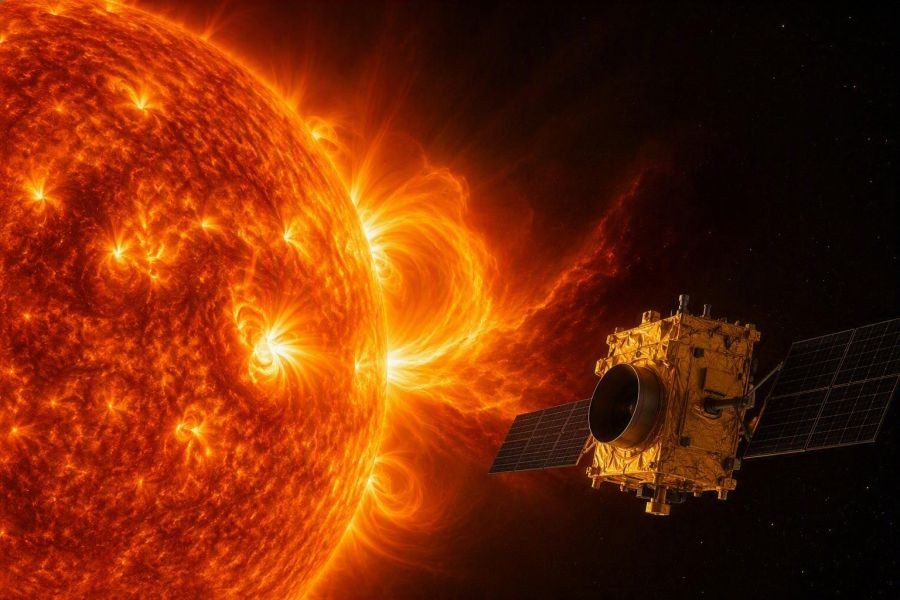
- Aditya-L1, India's first dedicated solar observation mission, was launched and has begun observing the Sun.
- On August 5, 2024, Aditya-L1's VELC recorded a particularly energetic coronal mass ejection (CME).
- Researchers led by Professor R. Ramesh of the Indian Institute of Astrophysics analyzed the CME data.
- The findings, published in the Astrophysical Journal Letters, quantified that magnetic field reconfiguration provides 93% of the energy needed to heat the corona, while surface waves contribute only 7%.
- The temperature structure of the Sun has puzzled astrophysicists for decades, with the core reaching nearly 15 million degrees Celsius and the visible surface, known as the photosphere, at around 5,500 degrees Celsius.
- The corona, located much farther from the core, can reach temperatures of around 2 million degrees Celsius and occasionally soar to as high as 40 million degrees Celsius.
- This phenomenon is known as the coronal heating problem and has remained one of the major unanswered questions in solar physics.
- The corona is also the source of solar flares and coronal mass ejections (CMEs), which release huge amounts of energy into space.
- Despite these massive energy losses through CMEs, the Sun doesn't seem to lose its energy and plunge into an irreversible deep freeze, suggesting that some mechanism is at work to keep the corona's temperature high.
Data from India's Aditya-L1 mission has shed light on the long-standing coronal heating problem, revealing that 93% of the energy maintaining the Sun's corona temperature comes from reconfiguring magnetic field lines. This finding was led by Professor R. Ramesh of the Indian Institute of Astrophysics and published in the Astrophysical Journal Letters.134678

The Sun's corona, which can reach temperatures of up to 40 million degrees Celsius, remains significantly hotter than its surface, which is around 5,500 degrees Celsius. This temperature discrepancy has puzzled scientists for decades, as the corona is constantly losing energy through solar eruptions, including coronal mass ejections (CMEs) and solar flares.5
During low activity periods, the Sun produces two to three CMEs daily, a number that can exceed ten during peak solar activity. Despite these energy losses, the corona's temperature remains high, suggesting a mechanism for energy replenishment. The study indicates that waves from boiling motions on the Sun's surface contribute only 7% of the energy needed, while the majority, 93%, is supplied by the reconfiguration of magnetic fields.9

The research utilized data from a particularly energetic CME recorded on August 5, 2024, by Aditya-L1's Visible Emission Line Coronagraph (VELC). The findings not only advance our understanding of solar physics but also have implications for predicting solar weather events that can disrupt technology on Earth.2
“The study, published in the Astrophysical Journal Letters, analyzed a CME recorded by Aditya-L1's VELC on August 5, 2024, finding that magnetic reconnection restored the corona's energy within 10 hours. This quantitative benchmark could improve space weather predictions, as CMEs can disrupt power grids and satellites.”
 MorungExpress