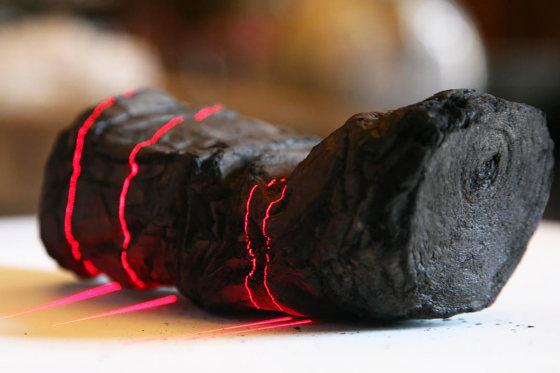
- Scientists have revealed insights from ancient scrolls buried by the eruption of nearly 2,000 years ago, after an AI breakthrough helped uncover some of their secrets.
- Researchers from the University of Kentucky and Naples on Thursday revealed recovered texts from authors previously lost to history, including philosophical takes on ethics, the arts, human behavior and theology.
- The PHerc. 1667 scroll has now been fully virtually unwrapped, allowing researchers to read nearly five feet of text across 20 columns.
- For the first time, scientists have succeeded in fully unwrapping one scroll, revealing an area measuring almost 1.5 meters (4.9 feet) of text across 20 columns.
- They used artificial intelligence to help them virtually unwrap the PHerc. 1667 scroll and tell the ink apart from the papyrus to decipher the letters.
- Gianluca del Mastro, professor of papyrology at Naples’ University Campania Luigi Vanvitelli, stated that in the past, it would take more than one month to decipher one phrase, but now they can get full texts.
- Scientists have recovered more than 70 columns of text from another scroll, PHerc. 172, which lives at the Bodleian Library at the University of Oxford in England.
- Newly translated texts include works by the Epicurean philosopher Philodemus, such as On Vices, Book 1 and On Gods, Book 8.
- The Vesuvius Challenge was launched by Brent Seales, a computer science professor at the University of Kentucky, to encourage researchers to decipher the scrolls by virtually unwrapping and decoding them.
- Many of these texts have been physically preserved but intellectually inaccessible for nearly two millennia.
- The scroll's handwriting and internal references suggest it dates from the second century BC or possibly from the late third century BC, making it one of the oldest scrolls in the collection.
- The first word revealed by the team working on the Vesuvius Challenge was 'porphyras,' the Greek word for purple.
- Philodemus' work 'On Gods' was established to be a series of at least eight books by the Greek philosopher.
Scientists have successfully deciphered ancient scrolls carbonized by Mount Vesuvius nearly 2,000 years ago, utilizing advanced AI techniques. The scroll, known as PHerc. 1667, has been virtually unwrapped, revealing almost 1.5 meters (4.9 feet) of text across 20 columns.
This breakthrough was announced during a press conference at the Biblioteca Nazionale di Napoli on June 25, 2023. The scroll was previously deemed unreadable, with a readability score of zero when partially opened in the 1980s. Brent Seales, a computer science professor at the University of Kentucky, leads the Vesuvius Challenge, which encourages global researchers to decode these texts without physically unrolling them.9
:max_bytes(150000):strip_icc():focal(749x0:751x2)/Mt.-Vesuvius-at-sunrise-062626-281278fa51624203b4b018a548844281.jpg)
The AI technology allows researchers to distinguish ink from papyrus, enabling them to read texts that have been inaccessible for centuries. “In the past, it would take more than one month to decipher one phrase. Now we get full texts,” said Gianluca del Mastro, a professor of papyrology at Naples’ University Campania Luigi Vanvitelli.6

Among the discoveries are works by the Epicurean philosopher Philodemus, including On Vices, Book 1 and On Gods, Book 8. This establishes that “On Gods” was a series of at least eight books by Philodemus, shedding light on ancient philosophical discussions about ethics and human behavior.
The Vesuvius Challenge has also announced a new $1 million prize for anyone who can decipher a complete scroll by June next year, further incentivizing research in this groundbreaking field.
“Researchers have successfully deciphered ancient scrolls that were burned during the Mount Vesuvius eruption nearly 2,000 years ago. This breakthrough, aided by AI, allows access to previously unreadable texts, including philosophical works by Philodemus.”




