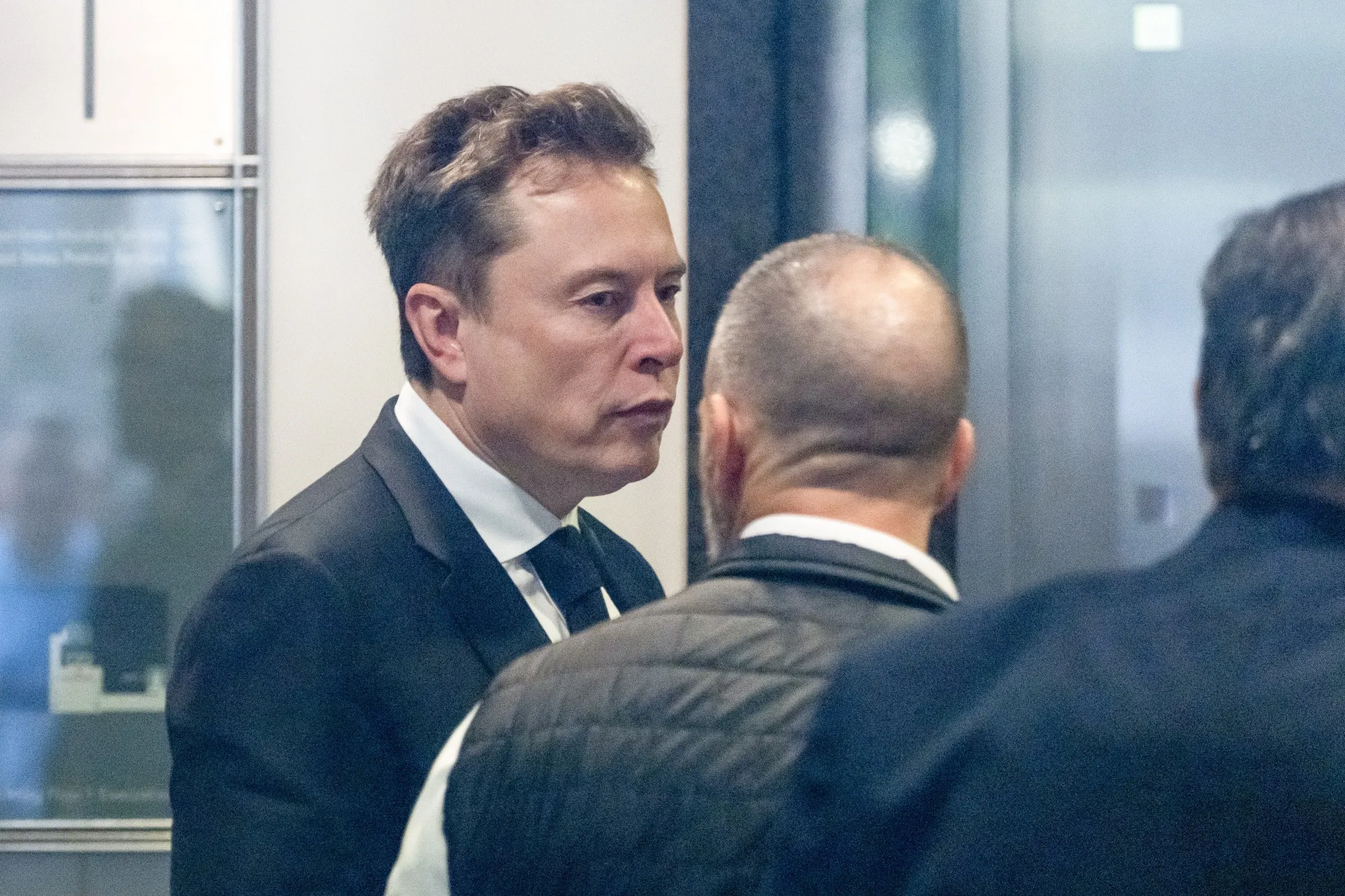
- Elon Musk lost a case against Sam Altman, with a jury ruling that he waited too long to bring his claims that OpenAI had betrayed its mission.
- The verdict was reached in federal court in Oakland, California, after a two-week trial over Musk and Altman's feud following their collaboration to launch OpenAI in 2015.
- A federal jury ruled against Elon Musk in his lawsuit accusing OpenAI of abandoning its nonprofit roots, finding that neither the tech company nor CEO Sam Altman could be held liable in the matter because Musk waited too long to bring the case.
- The jury delivered a unanimous verdict after deliberating for less than two hours on Monday morning, following 11 days of testimony and arguments in Oakland, California. They found all of Musk’s claims against the company and Altman to have exceeded the statute of limitations.
- Musk was a co-founder of OpenAI in 2015, but left the startup in 2018 after he was unable to persuade its other leaders to have OpenAI merge with Tesla or create a for-profit entity led by him.
- Musk accused OpenAI of violating its founding mission when the startup created a for-profit entity in 2019. His lawsuit sought the removal of OpenAI CEO Sam Altman and President Greg Brockman from their roles at the company.
- Musk sought over $150 billion in damages from OpenAI, which he said he would provide to OpenAI's nonprofit entity.
- OpenAI is now valued at $852 billion, and argued there was never a promise to keep the company nonprofit permanently.
- The company countered Musk's claims by noting that he pursued a merger with OpenAI and was involved in discussions about creating a for-profit entity before his departure from its board.
- They viewed the lawsuit as a tactic to boost Musk's own AI startup, xAI, as a competitor to OpenAI.
- A jury has found that OpenAI and its leaders, and Greg Brockman, along with Microsoft, are not liable for the lawsuit that Elon Musk brought against them in a much-publicized lawsuit.
- The judge in the case, Yvonne Gonzalez Rogers, has already dismissed Musk’s claims.
- The verdict brings a close to one chapter in a multi-year saga between Altman and Musk, who cofounded OpenAI together in 2015, but over the ensuing decade developed an relationship that eventually spilled over into a full-blown rivalry.
- Musk sued Sam Altman in mid-2024 for allegedly breaking OpenAI’s founding agreement to develop artificial general intelligence for the good of humanity—he held that OpenAI had done so by transitioning from a nonprofit to a for-profit enterprise.
- The trial in Oakland, California, on April 28 and lasted under three weeks, with the jury only beginning deliberations earlier today.
- Within 90 minutes, the jury returned with a unanimous decision that Musk’s claim is barred by the statute of limitations.
- According to the jury, Musk was aware of the behavior discussed in his complaint as far back as early 2021, meaning by the time he filed the lawsuit in summer 2024, the three-year limit had already passed.
- The verdict is an unambiguous victory for Altman, Brockman, and OpenAI.
- Musk had asked for $150 billion in damages and for Altman to be kicked off OpenAI’s board of directors.
- The move also clears OpenAI to continue moving forward toward a planned initial public offering, which could happen as soon as this year.
Elon Musk’s lawsuit against OpenAI and CEO Sam Altman has concluded with a unanimous jury verdict, rejecting Musk’s claims that the company strayed from its original nonprofit mission. The trial lasted two weeks before the jury determined that Musk’s allegations exceeded the statute of limitations.
Musk co-founded OpenAI in 2015 but departed in 2018 after failed attempts to steer the company towards a profit-driven model. The lawsuit accused OpenAI of violating its foundational mission by transitioning to a for-profit entity, a move he labeled as detrimental to its altruistic goal of AI development for humanity.
The jury found that Musk’s claims were time-barred, stating he was aware of the transition's implications as far back as early 2021. “Within 90 minutes, the jury returned with a unanimous decision that Musk’s claim is barred by the statute of limitations,” they noted. Musk had sought over $150 billion in damages and demanded the ousting of Altman and President Greg Brockman from their positions, arguing the company's direction contradicted its founding principles.3
The lawsuit was perceived by OpenAI as an attempt by Musk to promote his AI startup, xAI, against OpenAI. As a result of the verdict, OpenAI's path is now clear for a potential initial public offering (IPO), reportedly valuing the company at $852 billion.
“A federal jury unanimously ruled that Elon Musk's claim against Sam Altman and OpenAI was barred by the statute of limitations. This decision paves the way for OpenAI to proceed with its planned initial public offering as soon as this year.”


 Fox Business