- Static connectivity models create costly barriers when automakers need to adapt to network changes or expand services.
- The retirement of 3G networks forced OEMs across the industry to reassess how connected services could be maintained as underlying infrastructure evolved.
- Automakers are exploring software-provisioned connectivity to manage and update vehicle connections throughout the lifecycle.
- AI is being integrated into Software Defined Radio technology to enable adaptive, intelligent communication platforms.
- Connectivity decisions now impact vehicle programs, market expansion, and the ability to deliver new features.
- As software increasingly determines how vehicles perform, connectivity is becoming a defining strategic decision for automakers.
- The complexity of modern connectivity has elevated it from an engineering consideration to a broader operational concern.
- AI enhances flexibility in Software Defined Radio by enabling radios to analyze their electromagnetic environment and adapt communication parameters.
Automakers are shifting towards software-defined connectivity to manage vehicle connections throughout their lifecycle, allowing for updates and adaptations as market demands change. This approach is crucial as static models can lead to costly barriers and delays in service expansion.
As OEMs deliver more software-enabled features, they recognize that flexibility and long-term adaptability are essential. Connectivity decisions now significantly impact vehicle programs and market expansion, with the retirement of 3G networks prompting a reassessment of connected services.25
In parallel, artificial intelligence is revolutionizing Software Defined Radio (SDR), shifting traditional hardware functions into software. This transformation allows for a single radio platform to support multiple frequencies and communication standards, enhancing operational efficiency.
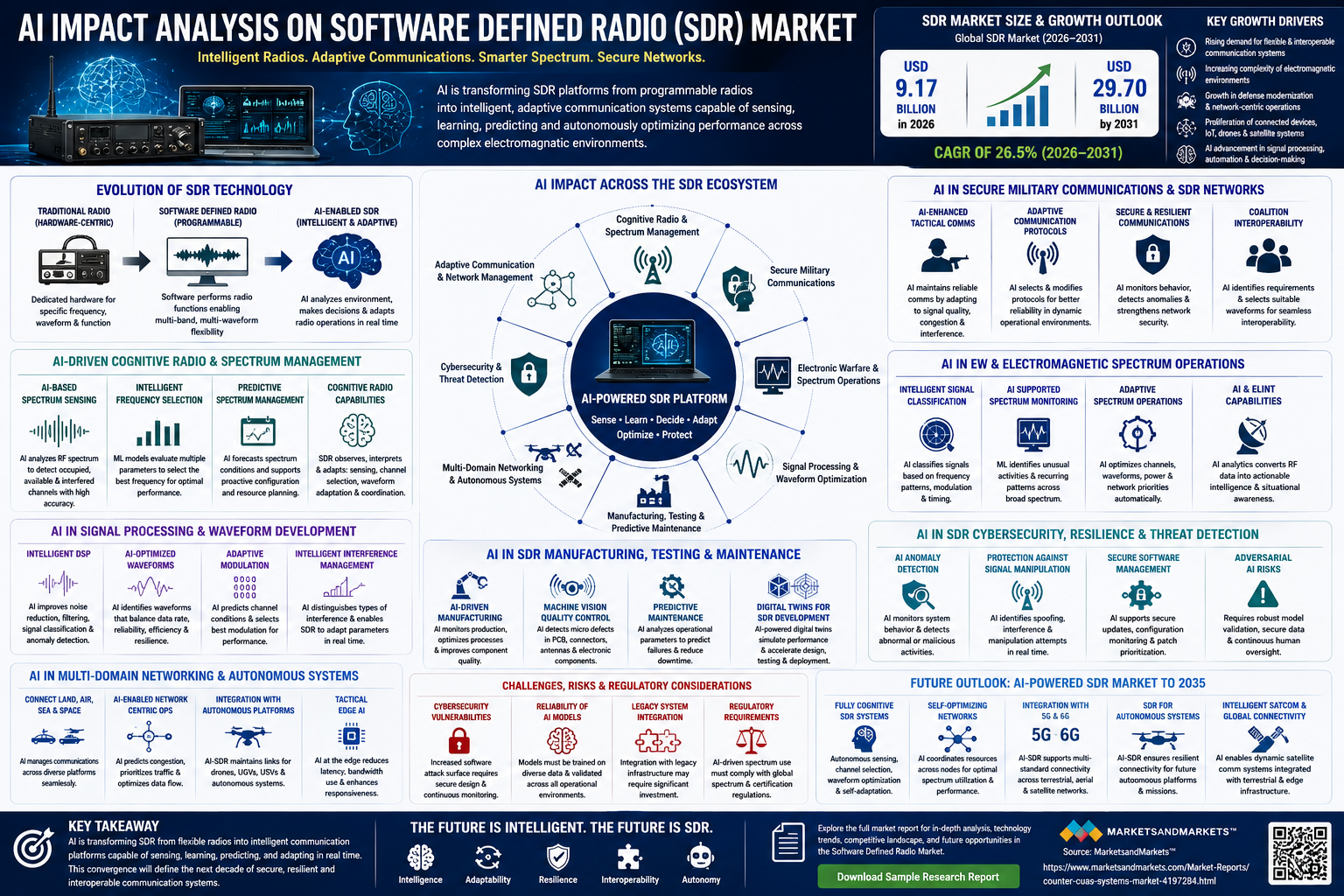
AI integration enables SDR platforms to analyze their environments, optimize spectrum usage, and support autonomous network operations. By 2035, AI is expected to influence nearly every aspect of the SDR ecosystem, transitioning from programmable radios to intelligent communication platforms capable of adapting to their surroundings.
The combination of software-defined connectivity and AI-driven SDR technology is set to redefine how automakers and communication systems operate, ensuring they remain agile in an increasingly complex landscape.
“The retirement of 3G networks forced OEMs to reassess how connected services are maintained, highlighting the cost of static connectivity. Software-provisioned models enable dynamic provisioning and support safety services like Next Generation eCall, reducing barriers to market expansion.”