
- AI integration now enables radios to analyze their environments, adapt communication parameters, and support autonomous operations.
- Between 2025 and 2035, AI is expected to influence almost every major aspect of the Software Defined Radio ecosystem.
- Traditional radio systems relied on dedicated hardware, which limited flexibility.
- Software Defined Radio shifted many hardware functions into software, enabling multi-standard support.
- Automakers are rethinking connectivity as a software-managed layer, moving from static models to software-provisioned approaches.
- Software Defined Radio introduced a different architecture in which software performs many functions traditionally handled by dedicated hardware.
- AI enhances flexibility by allowing radios to make data-driven decisions about how they should operate.
- AI enables radios to respond to changes in the electromagnetic environment much faster than conventional manual configuration approaches.
Artificial intelligence (AI) is revolutionizing the Software Defined Radio (SDR) market, transitioning it from traditional programmable hardware to intelligent platforms capable of adapting to dynamic spectrum conditions. This shift enhances operational efficiency and flexibility across various sectors, including military, public safety, and commercial communications.46
AI integration allows SDR systems to analyze electromagnetic environments, optimize communication parameters, and support autonomous operations. As a result, these platforms can identify interference, manage spectrum usage, and make real-time decisions, significantly improving communication performance.1
The demand for flexible spectrum utilization is driven by the rapid proliferation of connected devices and complex communication environments. Machine learning algorithms enable SDRs to process vast amounts of radio frequency data, detect patterns, and predict spectrum conditions, facilitating adaptive communications and enhancing interoperability across diverse networks.
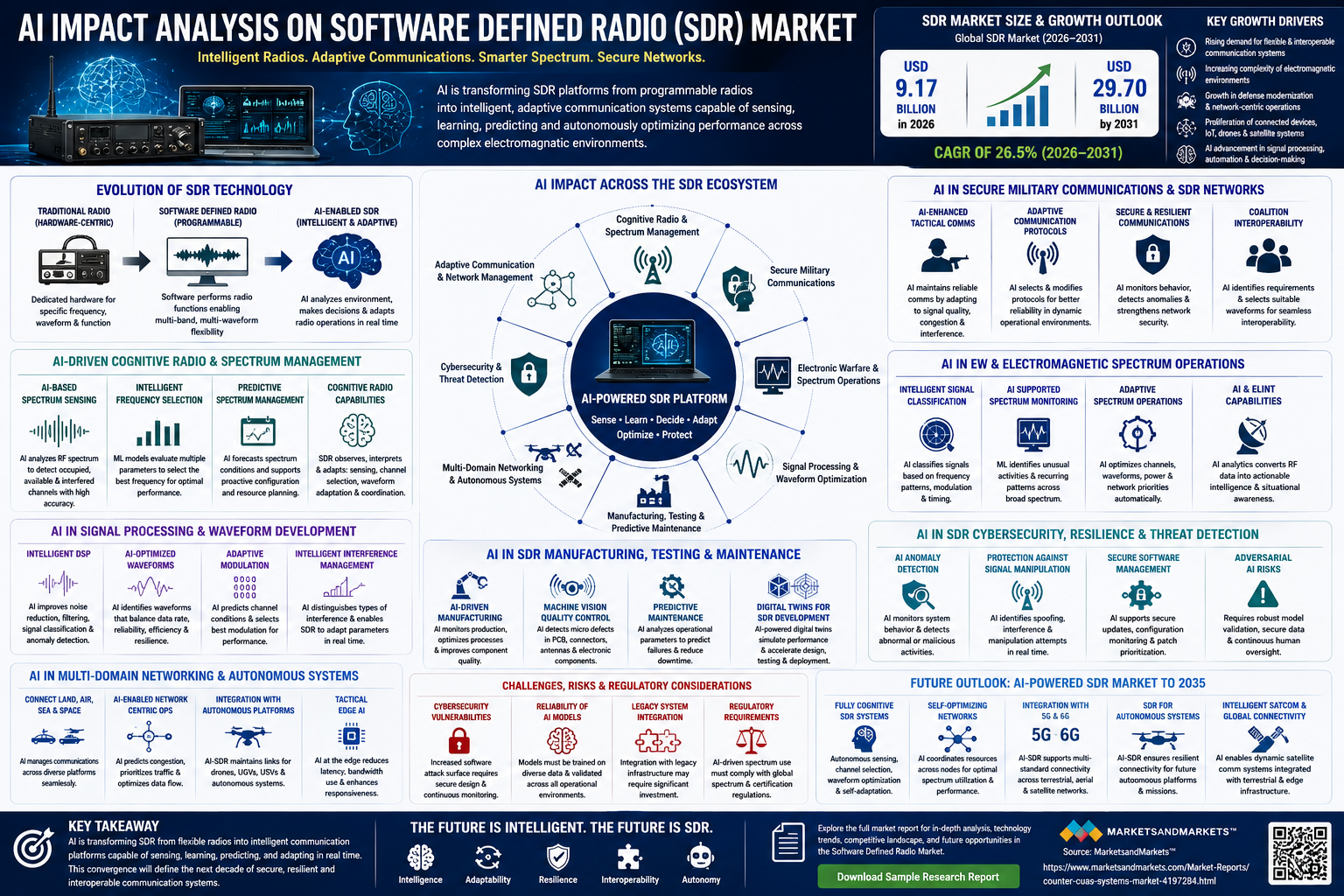
Between 2025 and 2035, AI is expected to influence nearly every aspect of the SDR ecosystem, contributing to cognitive radio capabilities, predictive maintenance, and cybersecurity. This evolution signifies a move from software-configurable radios to intelligent communication platforms that continuously adapt to their operating environments, ensuring that organizations can effectively manage their communication needs in an increasingly heterogeneous landscape.2
As the SDR market evolves, the integration of AI is set to redefine how communication systems operate, making them more responsive and capable of meeting the challenges posed by modern communication demands.
“Between 2025 and 2035, AI is expected to influence almost every major aspect of the SDR ecosystem, from cognitive radio to predictive maintenance. Automakers are also moving to software-provisioned connectivity, with 3G retirement forcing reassessment of connected services.”